Bearded Collies and Highland Sheep Work
Grit, Grace, and the Old Hill Instinct
Jeff Davis | https://herdingdogcentral.com
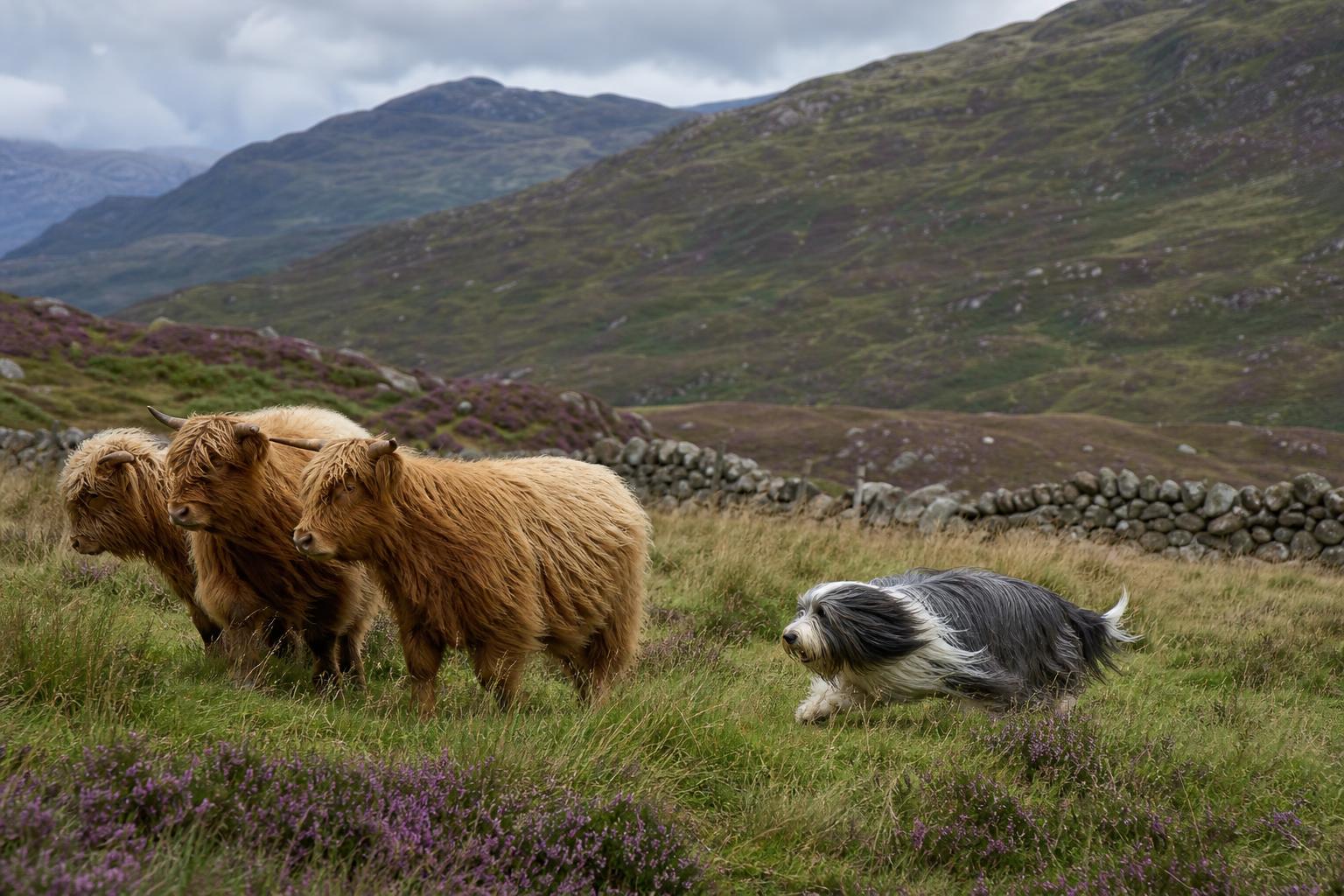
If you spend enough time around working dogs, you learn pretty quickly that not every breed fits every piece of country. Some dogs are made for tight pens and quick cattle pressure. Others come alive when the ground opens up, the wind cuts sideways, and sheep are scattered across rough hillsides that seem to go on forever. That is where the Bearded Collie has long had its reputation built, not in show rings or neat little demonstrations, but out in the kind of country that asks a dog to think for itself and keep going long after lesser workers have started to fade.
The Bearded Collie is one of those old practical breeds that makes more sense when you picture mud on the boots, wet wool in the air, and a shepherd needing a dog that can cover country without losing its head. In Highland sheep work, that matters more than flash ever will. These dogs were developed to gather, move, and manage sheep over uneven ground, through heather, across burns, and in weather that changes by the hour. A good Beardie does not just chase movement. It reads stock, handles pressure, and keeps enough composure to work a flock that would gladly break and climb if given half a chance.
The Highland Demands a Different Kind of Dog
Highland sheep work is not gentle on man, dog, or stock. The hills ask for endurance first. Then they ask for footwork, balance, initiative, and a mind steady enough to handle distance. Sheep in that sort of country are often light, active, and independent. They know the land better than you do, and if a dog comes in too hot or too foolish, they will split, bolt uphill, or vanish into folds of ground before the handler has time to swear about it.
That is why a true hill dog needs more than obedience. It needs judgment. The Bearded Collie has traditionally been valued for exactly that quality. There is a practical cleverness in a good one, the sort of common sense that cannot be faked. On a broad gather, when sheep are feeding wide and the weather is shifting, a Beardie can work with enough freedom to solve a problem without becoming wild or disconnected from the handler. That blend of independence and cooperation is one reason the breed has remained respected by people who know what real sheep work looks like.
Built for Tough Ground and Long Days
There is a tendency among modern dog owners to think first about appearance, but hill work does not care about pretty outlines. It cares about whether a dog can travel. A working Bearded Collie should move with efficiency and purpose, not wasted action. The body needs to be athletic, balanced, and durable. In Highland conditions, a dog may be asked to climb, descend, turn sharply on rough footing, and hold itself together over a full day of repeated effort.
The coat, often the first thing people notice, had a practical purpose in rough climates. It offered protection against wet, wind, and cold country. That does not mean every heavily coated Beardie is automatically fit for work, of course. Function has always mattered more than feathering. A serious working dog needs sound structure beneath the hair, along with lungs, heart, and the kind of stamina that only comes from good breeding and proper conditioning.
How Bearded Collies Work Sheep on the Hill
A Bearded Collie at its best works with a lively, capable style that suits difficult country. It can gather from distance, bring sheep off awkward slopes, and shift from an outrun into practical control without making stock feel hunted to death. The old shepherds prized dogs that could cast wide, stay sensible, and bring a packet of sheep in with enough calm that the whole job did not turn into a wreck. That remains the standard worth talking about.
One thing I have always admired in good hill dogs is the way they conserve effort. They do not waste themselves on noise and panic. They use position. A Beardie that understands stock will apply pressure where it matters, ease off when sheep are moving right, and step in firmly when a stubborn ewe decides she knows better. That kind of measured authority is pure gold in rough grazing country. You need a dog that can influence sheep without exciting them into foolishness.
Highland work also asks for adaptability. Sheep may be spread over broken ground, tucked behind rises, or drifting toward places where gathering them becomes twice the work. A Bearded Collie with genuine working instinct can sort that out on the move. It is not simply running because it was told to run. It is reading the stock, reading the contours, and putting itself where it can matter most.
Temperament Matters as Much as Instinct
For dog owners interested in herding dogs, temperament is often where the Bearded Collie becomes especially appealing. A hard-headed brute rarely makes the best all-around sheep dog. The breed has long been appreciated for being bright, willing, and biddable while still carrying enough grit to face difficult stock. That balance is not accidental. In Highland work, a dog may need to go out wide and work independently one minute, then settle close and handle sheep quietly near the fold the next.
A dog that is too soft may crumble under pressure. A dog that is too sharp may upset the flock and create more work than it solves. The Bearded Collie, when bred and trained for function, often sits in that useful middle ground. It has animation and spirit, but the best ones keep their brains about them. They are not just eager. They are useful.
Training a Bearded Collie for Real Sheep Work
No breed, no matter how traditional, arrives fully made. A young Bearded Collie still needs time on stock, clear handling, and enough patient miles to let instinct settle into skill. Highland sheep work especially exposes holes in training because distance magnifies every mistake. If a dog flanks too tight, grips without reason, or loses contact with the handler, the hill will show it fast.
Early work should focus on stock sense and steadiness. A Beardie pup with promise often shows natural interest, but that interest has to be shaped into controlled purpose. The trainer’s job is not to crush initiative; it is to channel it. You want the dog to keep its confidence while learning pace, balance, and responsibility. In rough country, confidence is a necessity. So is restraint.
One of the finest traits in a strong Bearded Collie is its willingness to keep trying. A good one can take correction, reset, and go back to work with heart still in it. That matters on sheep farms where conditions are not staged and lessons do not come neatly packaged. Sometimes the flock is sticky, sometimes it is wild, and sometimes the weather is miserable enough to test everyone involved. A trainable dog with mental resilience is worth a great deal.
Common Challenges Owners Should Understand
For modern owners drawn to the breed’s charm, there is an important truth to keep in mind: herding instinct needs an outlet and structure. A Bearded Collie bred from working roots may carry more drive, more initiative, and more sensitivity to movement than a casual pet home expects. Without proper work, training, and engagement, that energy can spill into nuisance behavior. These are not dogs meant to be mentally idle.
Another challenge is that not every dog wearing the breed name still reflects old working priorities. If your interest is in genuine sheep work, breeding matters tremendously. Look for lines with demonstrated herding ability, practical temperament, and physical soundness. A handsome coat and cheerful expression are pleasant things, but they do not gather scattered sheep off a wet hillside.
Why the Breed Still Deserves Respect
There is something deeply honest about a working Bearded Collie. In an age when many old breeds have drifted from their original purpose, the Beardie still tells a story about utility, endurance, and partnership. Highland sheep work shaped the breed into a dog that could think, travel, and face a hard day with enthusiasm. That heritage should not be treated like a quaint footnote. It is the very thing that gives the breed character.
When you watch a capable Beardie lift sheep from a distant slope and bring them on with calm control, you are seeing more than obedience. You are seeing generations of practical selection at work. The dog is not performing for applause. It is doing the job it was built to do. For those of us who value working dogs for their purpose first, that is where the real beauty lies.
For dog owners interested in herding dogs, the Bearded Collie offers a compelling lesson. A true herding breed is not defined by looks alone, nor by a tidy list of traits in a breed description. It is defined in the field, where instinct, nerve, stamina, and partnership all meet under pressure. In Highland sheep work, the Bearded Collie earned its name the old-fashioned way, by being useful in country that shows no mercy to pretenders.
That is why the breed remains worth knowing, worth preserving, and worth understanding beyond surface impressions. The good ones still carry the hill in them. And if you have ever watched a dog gather sheep out of rough weather with quiet authority, you know that kind of inheritance is something special.
The Bearded Collie is one of those old practical breeds that makes more sense when you picture mud on the boots, wet wool in the air, and a shepherd needing a dog that can cover country without losing its head. In Highland sheep work, that matters more than flash ever will. These dogs were developed to gather, move, and manage sheep over uneven ground, through heather, across burns, and in weather that changes by the hour. A good Beardie does not just chase movement. It reads stock, handles pressure, and keeps enough composure to work a flock that would gladly break and climb if given half a chance.
The Highland Demands a Different Kind of Dog
Highland sheep work is not gentle on man, dog, or stock. The hills ask for endurance first. Then they ask for footwork, balance, initiative, and a mind steady enough to handle distance. Sheep in that sort of country are often light, active, and independent. They know the land better than you do, and if a dog comes in too hot or too foolish, they will split, bolt uphill, or vanish into folds of ground before the handler has time to swear about it.
That is why a true hill dog needs more than obedience. It needs judgment. The Bearded Collie has traditionally been valued for exactly that quality. There is a practical cleverness in a good one, the sort of common sense that cannot be faked. On a broad gather, when sheep are feeding wide and the weather is shifting, a Beardie can work with enough freedom to solve a problem without becoming wild or disconnected from the handler. That blend of independence and cooperation is one reason the breed has remained respected by people who know what real sheep work looks like.
Built for Tough Ground and Long Days
There is a tendency among modern dog owners to think first about appearance, but hill work does not care about pretty outlines. It cares about whether a dog can travel. A working Bearded Collie should move with efficiency and purpose, not wasted action. The body needs to be athletic, balanced, and durable. In Highland conditions, a dog may be asked to climb, descend, turn sharply on rough footing, and hold itself together over a full day of repeated effort.
The coat, often the first thing people notice, had a practical purpose in rough climates. It offered protection against wet, wind, and cold country. That does not mean every heavily coated Beardie is automatically fit for work, of course. Function has always mattered more than feathering. A serious working dog needs sound structure beneath the hair, along with lungs, heart, and the kind of stamina that only comes from good breeding and proper conditioning.
How Bearded Collies Work Sheep on the Hill
A Bearded Collie at its best works with a lively, capable style that suits difficult country. It can gather from distance, bring sheep off awkward slopes, and shift from an outrun into practical control without making stock feel hunted to death. The old shepherds prized dogs that could cast wide, stay sensible, and bring a packet of sheep in with enough calm that the whole job did not turn into a wreck. That remains the standard worth talking about.
One thing I have always admired in good hill dogs is the way they conserve effort. They do not waste themselves on noise and panic. They use position. A Beardie that understands stock will apply pressure where it matters, ease off when sheep are moving right, and step in firmly when a stubborn ewe decides she knows better. That kind of measured authority is pure gold in rough grazing country. You need a dog that can influence sheep without exciting them into foolishness.
Highland work also asks for adaptability. Sheep may be spread over broken ground, tucked behind rises, or drifting toward places where gathering them becomes twice the work. A Bearded Collie with genuine working instinct can sort that out on the move. It is not simply running because it was told to run. It is reading the stock, reading the contours, and putting itself where it can matter most.
Temperament Matters as Much as Instinct
For dog owners interested in herding dogs, temperament is often where the Bearded Collie becomes especially appealing. A hard-headed brute rarely makes the best all-around sheep dog. The breed has long been appreciated for being bright, willing, and biddable while still carrying enough grit to face difficult stock. That balance is not accidental. In Highland work, a dog may need to go out wide and work independently one minute, then settle close and handle sheep quietly near the fold the next.
A dog that is too soft may crumble under pressure. A dog that is too sharp may upset the flock and create more work than it solves. The Bearded Collie, when bred and trained for function, often sits in that useful middle ground. It has animation and spirit, but the best ones keep their brains about them. They are not just eager. They are useful.
Training a Bearded Collie for Real Sheep Work
No breed, no matter how traditional, arrives fully made. A young Bearded Collie still needs time on stock, clear handling, and enough patient miles to let instinct settle into skill. Highland sheep work especially exposes holes in training because distance magnifies every mistake. If a dog flanks too tight, grips without reason, or loses contact with the handler, the hill will show it fast.
Early work should focus on stock sense and steadiness. A Beardie pup with promise often shows natural interest, but that interest has to be shaped into controlled purpose. The trainer’s job is not to crush initiative; it is to channel it. You want the dog to keep its confidence while learning pace, balance, and responsibility. In rough country, confidence is a necessity. So is restraint.
One of the finest traits in a strong Bearded Collie is its willingness to keep trying. A good one can take correction, reset, and go back to work with heart still in it. That matters on sheep farms where conditions are not staged and lessons do not come neatly packaged. Sometimes the flock is sticky, sometimes it is wild, and sometimes the weather is miserable enough to test everyone involved. A trainable dog with mental resilience is worth a great deal.
Common Challenges Owners Should Understand
For modern owners drawn to the breed’s charm, there is an important truth to keep in mind: herding instinct needs an outlet and structure. A Bearded Collie bred from working roots may carry more drive, more initiative, and more sensitivity to movement than a casual pet home expects. Without proper work, training, and engagement, that energy can spill into nuisance behavior. These are not dogs meant to be mentally idle.
Another challenge is that not every dog wearing the breed name still reflects old working priorities. If your interest is in genuine sheep work, breeding matters tremendously. Look for lines with demonstrated herding ability, practical temperament, and physical soundness. A handsome coat and cheerful expression are pleasant things, but they do not gather scattered sheep off a wet hillside.
Why the Breed Still Deserves Respect
There is something deeply honest about a working Bearded Collie. In an age when many old breeds have drifted from their original purpose, the Beardie still tells a story about utility, endurance, and partnership. Highland sheep work shaped the breed into a dog that could think, travel, and face a hard day with enthusiasm. That heritage should not be treated like a quaint footnote. It is the very thing that gives the breed character.
When you watch a capable Beardie lift sheep from a distant slope and bring them on with calm control, you are seeing more than obedience. You are seeing generations of practical selection at work. The dog is not performing for applause. It is doing the job it was built to do. For those of us who value working dogs for their purpose first, that is where the real beauty lies.
For dog owners interested in herding dogs, the Bearded Collie offers a compelling lesson. A true herding breed is not defined by looks alone, nor by a tidy list of traits in a breed description. It is defined in the field, where instinct, nerve, stamina, and partnership all meet under pressure. In Highland sheep work, the Bearded Collie earned its name the old-fashioned way, by being useful in country that shows no mercy to pretenders.
That is why the breed remains worth knowing, worth preserving, and worth understanding beyond surface impressions. The good ones still carry the hill in them. And if you have ever watched a dog gather sheep out of rough weather with quiet authority, you know that kind of inheritance is something special.