Bernese Mountain Dogs as Cart Dogs
A Working Tradition Worth Preserving
Jeff Davis | https://herdingdogcentral.com
 0
0 0
0 0
0 0
0 0
0
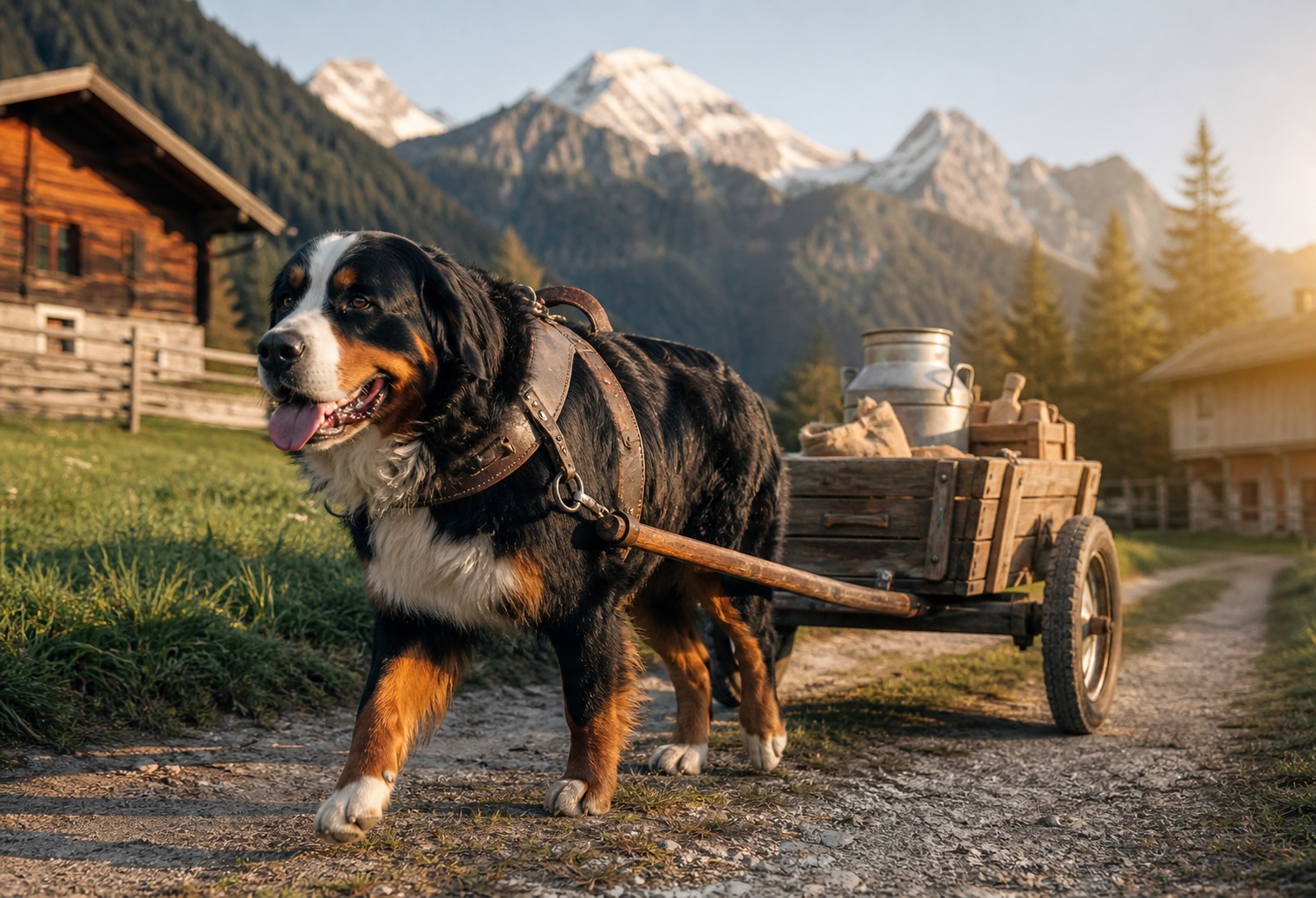
If you spend enough years around working dogs, you learn to look past the polished show coat and the sweet expression. A dog's real story is written in structure, gait, nerve, and willingness. The Bernese Mountain Dog is a fine example of that truth. Folks today often know the breed as a handsome family companion with a soft eye and a gentle way about it, but that picture is only half complete. The Bernese was shaped by labor. In the mountain valleys and farm country of Switzerland, these dogs pulled carts, moved goods, and helped ordinary people with ordinary hard work. That old draft heritage is not a novelty tacked onto the breed. It is part of its backbone.
For dog owners interested in herding and working breeds, understanding Bernese Mountain Dogs as cart dogs opens a deeper appreciation for what they were meant to do. This is not a breed that became useful by accident. The body, the mind, and the temperament all point back to a practical role. When a Berner leans into a harness with calm confidence, you are seeing a piece of history still alive.
The Working Roots of the Bernese Mountain Dog
The Bernese Mountain Dog came out of the Swiss Alps, where farm life demanded durable, all-purpose dogs. These were not pampered ornaments. They were expected to guard property, move livestock, and haul loads to market or around the farm. In that setting, a dog that could pull a small cart was no luxury. It was useful muscle where every pair of hands, and every set of shoulders, mattered.
The breed developed in the region around Bern, and that agricultural setting shaped what survived. A cart dog had to be strong without being clumsy. He had to stay level-headed around livestock, children, wagon noise, and rough ground. He needed enough drive to work, but not such a hot head that he wasted effort or invited trouble. That balance is one of the Bernese Mountain Dog's greatest strengths. They are powerful, but they are not frantic. They are willing, but they are not reckless.
I have always respected dogs that know how to settle into a job. Some breeds attack work like a spark in dry grass. Others, like the Bernese, carry it more like a steady engine. For draft work, that steady engine matters. Pulling a cart requires patience, coordination, and trust. A dog that panics at pressure in the traces or loses his head over a shifting load is not much use. The Bernese earned its reputation because it could handle responsibility.
Why Bernese Mountain Dogs Excel at Carting
Strength and structure
A Bernese Mountain Dog has the frame for draft work. The breed is large, well-boned, and muscular, with a body built to generate pulling power. Good shoulder layback, a solid topline, and strong hindquarters all contribute to efficient movement in harness. You do not want brute force alone in a cart dog. You want balanced power, the kind that can move a load smoothly without pounding itself to pieces.
That is where proper breeding and sound structure matter. A well-made Berner carries himself with purpose. He should move cleanly, with reach and drive, and have the physical steadiness needed to pull with control. A poorly built dog may still be willing, but willingness cannot overcome bad mechanics for long.
Temperament suited to work
The Bernese temperament is another reason the breed took naturally to carting. These dogs are generally calm, affectionate, and eager to stay connected to their people. That human-oriented nature made them practical farm partners. A cart dog has to listen, accept guidance, and work near people without creating confusion. Berners tend to have that cooperative streak.
There is also a quiet confidence in a good one. Not every Berner is bold in the same way, and some are softer than others, but the breed at its best has a dependable, thoughtful quality. In the field and around stock, I have always preferred a dog that thinks before it reacts. The same goes for draft work. A dog hitched to a cart needs steadiness more than flash.
A natural fit for useful labor
Some breeds seem happiest when they can throw themselves into motion. Bernese Mountain Dogs often seem happiest when they can share a task with their people. Carting suits that instinct beautifully. It gives the dog a clear job, a measured pace, and a sense of purpose. For modern owners, that can be one of the finest ways to honor the breed's heritage without asking the dog to live in a nineteenth-century Swiss farmyard.
What Cart Work Looks Like Today
Modern carting with Bernese Mountain Dogs ranges from light recreational work to organized draft tests and demonstrations. In many cases, owners train their dogs to pull empty carts at first, then gradually add safe, appropriate weight as the dog matures and gains confidence. Some teams participate in club events where the dog maneuvers through turns, halts, backing exercises, and practical hauling tasks. Others simply enjoy controlled carting as a working pastime.
The important point is that true draft work is not about showing off how much weight a dog can drag. Good carting is about form, confidence, training, and safety. The old farm dogs were valued because they were useful and reliable, not because they were pushed into foolish feats. Any owner interested in Bernese Mountain Dogs as cart dogs should keep that in mind. Strength is part of the picture, but judgment is the part that keeps a dog sound.
Training a Bernese Mountain Dog for Carting
Start with maturity and basics
A young Berner may have the size to impress you before he has the physical maturity to handle draft work. That is a mistake many eager owners make. Formal pulling should wait until the dog's growth and joint development are far enough along to support it safely. Before a dog ever steps into a harness, he should understand basic obedience, stand calmly for handling, and move confidently on lead.
The best cart dogs are not rushed. They are educated. First the dog learns to wear equipment, then to accept shafts or traces beside him, then to pull light resistance, and finally to work with a cart. Every stage should be quiet and matter-of-fact. If the dog gets worried, back up and simplify. The goal is a dog that trusts the process, not one that merely tolerates it.
Build confidence, not anxiety
I have seen more than one promising working dog spoiled by a handler in too much of a hurry. Harness noise, rolling wheels, shifting weight, and narrow spaces can all unsettle a dog if introduced poorly. Berners generally respond best to calm repetition and patient guidance. They do not need drama. They need clarity.
Reward composure. Keep sessions short at first. Let the dog learn that pressure in the harness means move forward steadily, not explode or freeze. Once that lesson settles in, the rest becomes easier. A confident cart dog looks almost proud in harness. There is a different carriage to him, a kind of collected purpose that tells you he understands the assignment.
Safety and Health Considerations
Because Bernese Mountain Dogs are a large breed, owners need to be honest about conditioning, joints, and overall health. Not every Berner is suited for draft work, and not every dog that enjoys pulling should be worked hard. The breed can be prone to orthopedic issues, and heavy work on poor surfaces or with improper equipment can do lasting harm.
A proper draft harness is essential. So is a cart fitted to the dog's size and movement. Weight should be introduced conservatively and increased only when the dog is physically mature, properly conditioned, and working with ease. Hot weather is another serious concern. A thick-coated Bernese can overheat faster than many owners realize, especially when exerting itself. Cool conditions, level footing, and common sense are part of responsible carting.
There is no glory in overfacing a dog. The finest working men and women I have known always kept something in reserve in their dogs. They asked for honest effort and protected the animal that gave it. That old ethic should still guide modern owners.
The Value of Carting for Modern Berners
One reason carting remains so meaningful is that it gives the Bernese Mountain Dog a chance to express inherited purpose. We ask a lot of working breeds when we place them in suburban homes and expect them to be content with very little to do. A Berner may be affectionate and easygoing indoors, but that does not erase generations of utility behind him.
Carting can provide mental engagement, physical conditioning, and a stronger bond between dog and handler. It also offers owners a practical way to connect with the breed beyond appearance. When you see a Bernese moving in harness with a relaxed mouth, focused eyes, and a load rolling smoothly behind him, you begin to understand the breed in a way no pedigree chart can teach.
For families, draft work can also become a tradition. There is something old-fashioned and deeply satisfying about training a dog for useful work, even if that work today is largely ceremonial or recreational. It reminds us that dogs were once partners in labor as much as companions by the fire.
Preserving the Bernese Mountain Dog's Heritage
The Bernese Mountain Dog should never be reduced to a pretty coat and a pleasant disposition. Those are fine traits, but they are not the whole dog. The breed's carting history deserves attention because it explains so much of what a good Berner is meant to be: strong, steady, biddable, and useful.
Owners who explore carting are doing more than trying a hobby. They are preserving a working tradition that helped shape one of the world's most beloved farm dogs. In a time when many old canine jobs are fading into memory, that matters. It keeps the breed tied to reality. It keeps breeding goals honest. And it gives the dog a chance to do something that still fits both body and spirit.
Bernese Mountain Dogs as cart dogs are not a romantic invention from some painted postcard of the Alps. They are the real article, built out of practical need and proven by generations of work. If you own a Berner, or hope to, it is worth remembering that beneath the gentle expression stands a dog bred to pull, serve, and stay steady under load. In my book, that is a heritage worth respecting.
For dog owners interested in herding and working breeds, understanding Bernese Mountain Dogs as cart dogs opens a deeper appreciation for what they were meant to do. This is not a breed that became useful by accident. The body, the mind, and the temperament all point back to a practical role. When a Berner leans into a harness with calm confidence, you are seeing a piece of history still alive.
The Working Roots of the Bernese Mountain Dog
The Bernese Mountain Dog came out of the Swiss Alps, where farm life demanded durable, all-purpose dogs. These were not pampered ornaments. They were expected to guard property, move livestock, and haul loads to market or around the farm. In that setting, a dog that could pull a small cart was no luxury. It was useful muscle where every pair of hands, and every set of shoulders, mattered.
The breed developed in the region around Bern, and that agricultural setting shaped what survived. A cart dog had to be strong without being clumsy. He had to stay level-headed around livestock, children, wagon noise, and rough ground. He needed enough drive to work, but not such a hot head that he wasted effort or invited trouble. That balance is one of the Bernese Mountain Dog's greatest strengths. They are powerful, but they are not frantic. They are willing, but they are not reckless.
I have always respected dogs that know how to settle into a job. Some breeds attack work like a spark in dry grass. Others, like the Bernese, carry it more like a steady engine. For draft work, that steady engine matters. Pulling a cart requires patience, coordination, and trust. A dog that panics at pressure in the traces or loses his head over a shifting load is not much use. The Bernese earned its reputation because it could handle responsibility.
Why Bernese Mountain Dogs Excel at Carting
Strength and structure
A Bernese Mountain Dog has the frame for draft work. The breed is large, well-boned, and muscular, with a body built to generate pulling power. Good shoulder layback, a solid topline, and strong hindquarters all contribute to efficient movement in harness. You do not want brute force alone in a cart dog. You want balanced power, the kind that can move a load smoothly without pounding itself to pieces.
That is where proper breeding and sound structure matter. A well-made Berner carries himself with purpose. He should move cleanly, with reach and drive, and have the physical steadiness needed to pull with control. A poorly built dog may still be willing, but willingness cannot overcome bad mechanics for long.
Temperament suited to work
The Bernese temperament is another reason the breed took naturally to carting. These dogs are generally calm, affectionate, and eager to stay connected to their people. That human-oriented nature made them practical farm partners. A cart dog has to listen, accept guidance, and work near people without creating confusion. Berners tend to have that cooperative streak.
There is also a quiet confidence in a good one. Not every Berner is bold in the same way, and some are softer than others, but the breed at its best has a dependable, thoughtful quality. In the field and around stock, I have always preferred a dog that thinks before it reacts. The same goes for draft work. A dog hitched to a cart needs steadiness more than flash.
A natural fit for useful labor
Some breeds seem happiest when they can throw themselves into motion. Bernese Mountain Dogs often seem happiest when they can share a task with their people. Carting suits that instinct beautifully. It gives the dog a clear job, a measured pace, and a sense of purpose. For modern owners, that can be one of the finest ways to honor the breed's heritage without asking the dog to live in a nineteenth-century Swiss farmyard.
What Cart Work Looks Like Today
Modern carting with Bernese Mountain Dogs ranges from light recreational work to organized draft tests and demonstrations. In many cases, owners train their dogs to pull empty carts at first, then gradually add safe, appropriate weight as the dog matures and gains confidence. Some teams participate in club events where the dog maneuvers through turns, halts, backing exercises, and practical hauling tasks. Others simply enjoy controlled carting as a working pastime.
The important point is that true draft work is not about showing off how much weight a dog can drag. Good carting is about form, confidence, training, and safety. The old farm dogs were valued because they were useful and reliable, not because they were pushed into foolish feats. Any owner interested in Bernese Mountain Dogs as cart dogs should keep that in mind. Strength is part of the picture, but judgment is the part that keeps a dog sound.
Training a Bernese Mountain Dog for Carting
Start with maturity and basics
A young Berner may have the size to impress you before he has the physical maturity to handle draft work. That is a mistake many eager owners make. Formal pulling should wait until the dog's growth and joint development are far enough along to support it safely. Before a dog ever steps into a harness, he should understand basic obedience, stand calmly for handling, and move confidently on lead.
The best cart dogs are not rushed. They are educated. First the dog learns to wear equipment, then to accept shafts or traces beside him, then to pull light resistance, and finally to work with a cart. Every stage should be quiet and matter-of-fact. If the dog gets worried, back up and simplify. The goal is a dog that trusts the process, not one that merely tolerates it.
Build confidence, not anxiety
I have seen more than one promising working dog spoiled by a handler in too much of a hurry. Harness noise, rolling wheels, shifting weight, and narrow spaces can all unsettle a dog if introduced poorly. Berners generally respond best to calm repetition and patient guidance. They do not need drama. They need clarity.
Reward composure. Keep sessions short at first. Let the dog learn that pressure in the harness means move forward steadily, not explode or freeze. Once that lesson settles in, the rest becomes easier. A confident cart dog looks almost proud in harness. There is a different carriage to him, a kind of collected purpose that tells you he understands the assignment.
Safety and Health Considerations
Because Bernese Mountain Dogs are a large breed, owners need to be honest about conditioning, joints, and overall health. Not every Berner is suited for draft work, and not every dog that enjoys pulling should be worked hard. The breed can be prone to orthopedic issues, and heavy work on poor surfaces or with improper equipment can do lasting harm.
A proper draft harness is essential. So is a cart fitted to the dog's size and movement. Weight should be introduced conservatively and increased only when the dog is physically mature, properly conditioned, and working with ease. Hot weather is another serious concern. A thick-coated Bernese can overheat faster than many owners realize, especially when exerting itself. Cool conditions, level footing, and common sense are part of responsible carting.
There is no glory in overfacing a dog. The finest working men and women I have known always kept something in reserve in their dogs. They asked for honest effort and protected the animal that gave it. That old ethic should still guide modern owners.
The Value of Carting for Modern Berners
One reason carting remains so meaningful is that it gives the Bernese Mountain Dog a chance to express inherited purpose. We ask a lot of working breeds when we place them in suburban homes and expect them to be content with very little to do. A Berner may be affectionate and easygoing indoors, but that does not erase generations of utility behind him.
Carting can provide mental engagement, physical conditioning, and a stronger bond between dog and handler. It also offers owners a practical way to connect with the breed beyond appearance. When you see a Bernese moving in harness with a relaxed mouth, focused eyes, and a load rolling smoothly behind him, you begin to understand the breed in a way no pedigree chart can teach.
For families, draft work can also become a tradition. There is something old-fashioned and deeply satisfying about training a dog for useful work, even if that work today is largely ceremonial or recreational. It reminds us that dogs were once partners in labor as much as companions by the fire.
Preserving the Bernese Mountain Dog's Heritage
The Bernese Mountain Dog should never be reduced to a pretty coat and a pleasant disposition. Those are fine traits, but they are not the whole dog. The breed's carting history deserves attention because it explains so much of what a good Berner is meant to be: strong, steady, biddable, and useful.
Owners who explore carting are doing more than trying a hobby. They are preserving a working tradition that helped shape one of the world's most beloved farm dogs. In a time when many old canine jobs are fading into memory, that matters. It keeps the breed tied to reality. It keeps breeding goals honest. And it gives the dog a chance to do something that still fits both body and spirit.
Bernese Mountain Dogs as cart dogs are not a romantic invention from some painted postcard of the Alps. They are the real article, built out of practical need and proven by generations of work. If you own a Berner, or hope to, it is worth remembering that beneath the gentle expression stands a dog bred to pull, serve, and stay steady under load. In my book, that is a heritage worth respecting.