German Shepherds as Historic Herding Dogs
Jeff Davis | https://herdingdogcentral.com
 0
0 0
0 0
0 0
0 0
0
The Original Work Behind the Legend
Ask most folks what a German Shepherd was bred to do, and you will usually hear about patrol work, military service, guarding, or police duty. That is understandable. The breed has earned that reputation many times over. But long before the uniform, the decoy, or the patrol car, the German Shepherd was a practical herding dog built for the day-in, day-out demands of moving livestock across rough country.
That piece of the breed’s history matters, especially for dog owners trying to understand why German Shepherds think, move, and react the way they do. A breed does not lose its foundation just because the modern world gives it a new job title. Spend enough time around working dogs, in fields or on stock, and you learn something simple: old instincts have a way of showing themselves. The German Shepherd still carries that old herding heart, even if many people no longer recognize it.
From the perspective of a man who has watched good dogs read animals and terrain with the kind of sense you cannot train into a soft-minded dog, I have always respected the German Shepherd’s roots. This is not a breed that was put together for looks first. It was shaped by usefulness. It had to think on the move, handle pressure, stay loyal to its handler, and work with enough authority to influence stock without breaking apart under stress. Those are herding qualities through and through.
Where German Shepherd Herding History Began
The German Shepherd developed in late nineteenth-century Germany from regional herding and farm dogs that varied in coat, color, size, and style. What tied them together was not appearance but function. These dogs were expected to gather, guide, and protect sheep while remaining responsive to the shepherd. In many parts of Germany, a dog needed to do more than simply push stock from one place to another. It had to patrol boundaries, keep animals together, watch for trouble, and make steady decisions without constant micromanagement.
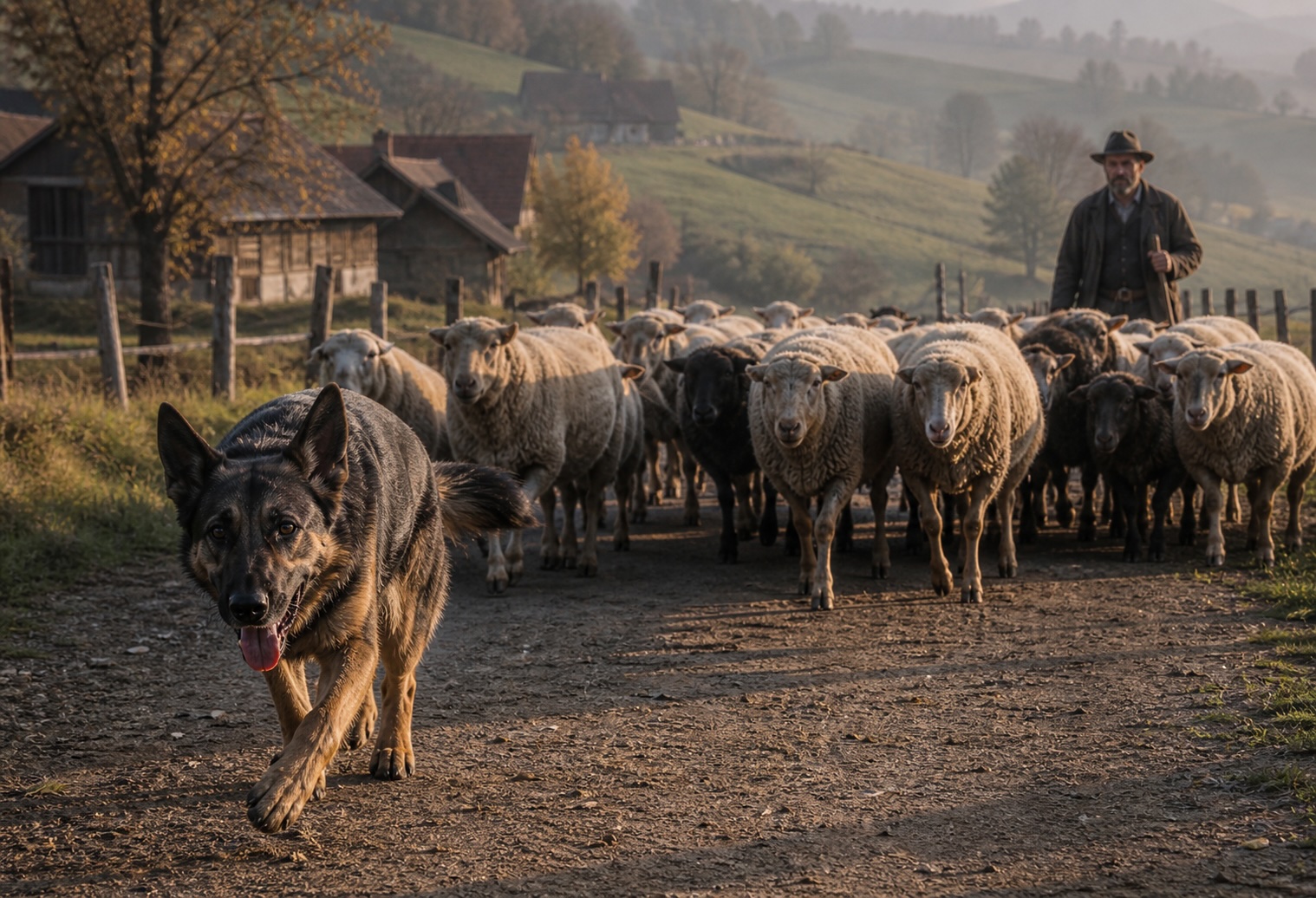
That broader responsibility is important. Some herding breeds are famous for eye and crouch, some for heel and force, and some for loose gathering over wide country. The early German Shepherd type was valued for tending-style herding. Instead of casting way out and bringing stock back in the manner of a Border Collie, these dogs often worked as living fences. They moved flocks along roads, fields, and shared lands, keeping sheep off cultivated ground and under control. It required attention, endurance, and a calm kind of authority.
Max von Stephanitz, the man most closely associated with formalizing the breed, saw tremendous value in these working dogs. He wanted a national utility dog, one defined by serviceability above all else. When he founded the breed standard, his aim was not to create a showpiece. He wanted a capable worker with sound nerves, a strong body, intelligence, and biddability. Herding was central to that original vision.
Function Came Before Fame
That old saying that utility is the true criterion of beauty fits the German Shepherd better than most breeds. The dog’s structure, movement, and mind were all meant to support long hours of useful work. A shepherd could not afford a flashy dog that quit at noon, nor a hard dog that scattered sheep every time pressure rose. The dog had to think cleanly. It had to cover ground efficiently. It had to remain reliable in changing conditions, whether dealing with skittish stock, poor weather, or long distances.
Those practical needs shaped a breed with unusual versatility. Once people saw what these dogs could do, it was only natural that they would be tested in other jobs. Guarding, military work, tracking, and protection did not appear out of nowhere. They grew from the same base traits that made the breed effective with stock: nerve, intelligence, loyalty, trainability, and physical stamina.
How German Shepherds Worked Livestock
To understand German Shepherds as historic herding dogs, it helps to picture the actual work. This was not always the dramatic gathering style many people imagine when they think of sheepdogs. A tending dog often worked close enough to influence movement at the edge of a flock, drifting along a boundary, correcting an animal that tried to break away, and maintaining order over time. That takes discipline. A hot-headed dog can ruin stock in a hurry. A dull dog gets ignored. The right dog applies just enough pressure, then eases off.
German Shepherds were prized for that blend of attentiveness and authority. They could move sheep down roads and across fields while discouraging straying into planted crops. In that role, they served the shepherd and the landowner alike. Their work was as much about control as motion. It was not random chasing. It was thoughtful livestock management done at a canine level.
I have always admired dogs that can make animals believe moving in the right direction was their own idea. That is a finer skill than brute force. Good herding dogs understand pressure, timing, and space. Historically, German Shepherds earned their keep by showing all three.
The Traits That Made Them Effective
Several qualities helped the breed succeed in herding work. Intelligence sits near the top, but intelligence alone is not enough. Plenty of smart dogs are hard to trust because their minds run ahead of their obedience. The German Shepherd was expected to think independently while staying tied to the handler’s intent. That balance is gold in any working breed.
Endurance mattered too. These dogs were built for sustained movement rather than short bursts of showy effort. Their gait and general athleticism supported long working days. They also carried a protective instinct that made sense in a pastoral setting. A dog responsible for sheep and property needed to be alert to threats and confident enough to stand its ground when necessary.
Then there is trainability. Historic herding dogs had to respond to commands, body language, routine, and changing tasks. The German Shepherd became known for learning quickly and retaining lessons well, which only increased its value beyond the pasture. Once breeders and trainers recognized that adaptability, the breed’s future widened dramatically.
Why the Breed Shifted Away From Herding
The world changed, and with it the work. Industrialization, modern fencing, rail transport, urban expansion, and changing agricultural practices reduced the everyday need for traditional tending dogs in many areas. As the practical demand for herding declined, other roles came forward. The German Shepherd proved so capable in service work that public attention followed those jobs instead.
It is easy to see why. A breed that can herd, guard, track, protect, and partner closely with people is going to be noticed. Over time, the image of the German Shepherd shifted from pastoral worker to all-purpose service dog. That did not erase the breed’s herding ancestry, but it did push it into the background.
Selective breeding also played a role. As lines developed for police work, sport, companionship, or conformation, fewer dogs were bred specifically with stock work in mind. In any breed, when a job stops being tested, some of the finer working edges begin to dull. Still, in many German Shepherds, the old instincts remain close enough to the surface that experienced handlers can spot them in the way the dog watches movement, controls space, and reacts to livestock or even household motion.
What Modern Owners Should Understand
For today’s dog owner, the biggest takeaway is simple: the German Shepherd’s mind was shaped by work. Even if your dog never sees a sheep, the breed’s historic herding background helps explain its behavior. Many German Shepherds are highly aware of movement, strongly attached to family, eager for structure, and restless when underworked. They often want a job because, for generations, having a job was the point.
This is where many owners get into trouble. They bring home a German Shepherd because they admire its looks or loyalty, but they underestimate the dog’s need for direction. A dog bred to manage stock and solve problems on the move will often invent its own work if you do not provide any. That might look like pacing fences, circling children, reacting to bicycles, over-guarding the home, or becoming noisy and difficult when bored.
Understanding the breed’s herding roots gives owners a better roadmap. Training should be consistent and purposeful. Exercise should include mental work, not just miles. Obedience, scent games, structured play, task-based routines, and advanced training all help satisfy the mind that once helped shepherds manage flocks across open land.
Herding Instinct Still Shows Up
Not every German Shepherd will display clear stock-dog ability, and not every line is equally close to that heritage. Even so, the old design can still be seen. Some dogs naturally gather family members together, monitor doors and boundaries, or show a noticeable sensitivity to movement and position. Those are not random quirks. They are echoes of the breed’s original function.
For owners interested in heritage work, herding instinct tests and stock exposure under experienced supervision can be eye-opening. A dog that has never seen sheep may still show interest, control, and surprising composure around livestock. Watching that switch flip can tell you more about breed history than any pedigree chart ever could.
The Lasting Legacy of the German Shepherd as a Herding Dog
The German Shepherd’s fame in protection and service circles should never overshadow where the breed came from. This dog was built in the practical world of livestock, land, and daily labor. Its reputation for intelligence and courage was not invented in modern training clubs. It was earned in the fields, on the roads, and beside shepherds who depended on a dog that could work honestly and think for itself.
That heritage still matters. It explains the breed’s intensity, loyalty, confidence, and need for meaningful engagement. It also reminds us that the finest working dogs are rarely accidents. They are shaped by necessity, refined by real jobs, and proven over time. The German Shepherd is one of the clearest examples of that truth.
If you own one today, you are living with more than a famous breed. You are living with the descendant of a historic herding dog, one whose instincts were forged in useful work and close partnership with people. Respect that history, and you will understand the dog in front of you far better. Ignore it, and you may spend years wondering why such a smart dog seems to need so much purpose. The answer was there from the beginning, out in the pasture.
Ask most folks what a German Shepherd was bred to do, and you will usually hear about patrol work, military service, guarding, or police duty. That is understandable. The breed has earned that reputation many times over. But long before the uniform, the decoy, or the patrol car, the German Shepherd was a practical herding dog built for the day-in, day-out demands of moving livestock across rough country.
That piece of the breed’s history matters, especially for dog owners trying to understand why German Shepherds think, move, and react the way they do. A breed does not lose its foundation just because the modern world gives it a new job title. Spend enough time around working dogs, in fields or on stock, and you learn something simple: old instincts have a way of showing themselves. The German Shepherd still carries that old herding heart, even if many people no longer recognize it.
From the perspective of a man who has watched good dogs read animals and terrain with the kind of sense you cannot train into a soft-minded dog, I have always respected the German Shepherd’s roots. This is not a breed that was put together for looks first. It was shaped by usefulness. It had to think on the move, handle pressure, stay loyal to its handler, and work with enough authority to influence stock without breaking apart under stress. Those are herding qualities through and through.
Where German Shepherd Herding History Began
The German Shepherd developed in late nineteenth-century Germany from regional herding and farm dogs that varied in coat, color, size, and style. What tied them together was not appearance but function. These dogs were expected to gather, guide, and protect sheep while remaining responsive to the shepherd. In many parts of Germany, a dog needed to do more than simply push stock from one place to another. It had to patrol boundaries, keep animals together, watch for trouble, and make steady decisions without constant micromanagement.
That broader responsibility is important. Some herding breeds are famous for eye and crouch, some for heel and force, and some for loose gathering over wide country. The early German Shepherd type was valued for tending-style herding. Instead of casting way out and bringing stock back in the manner of a Border Collie, these dogs often worked as living fences. They moved flocks along roads, fields, and shared lands, keeping sheep off cultivated ground and under control. It required attention, endurance, and a calm kind of authority.
Max von Stephanitz, the man most closely associated with formalizing the breed, saw tremendous value in these working dogs. He wanted a national utility dog, one defined by serviceability above all else. When he founded the breed standard, his aim was not to create a showpiece. He wanted a capable worker with sound nerves, a strong body, intelligence, and biddability. Herding was central to that original vision.
Function Came Before Fame
That old saying that utility is the true criterion of beauty fits the German Shepherd better than most breeds. The dog’s structure, movement, and mind were all meant to support long hours of useful work. A shepherd could not afford a flashy dog that quit at noon, nor a hard dog that scattered sheep every time pressure rose. The dog had to think cleanly. It had to cover ground efficiently. It had to remain reliable in changing conditions, whether dealing with skittish stock, poor weather, or long distances.
Those practical needs shaped a breed with unusual versatility. Once people saw what these dogs could do, it was only natural that they would be tested in other jobs. Guarding, military work, tracking, and protection did not appear out of nowhere. They grew from the same base traits that made the breed effective with stock: nerve, intelligence, loyalty, trainability, and physical stamina.
How German Shepherds Worked Livestock
To understand German Shepherds as historic herding dogs, it helps to picture the actual work. This was not always the dramatic gathering style many people imagine when they think of sheepdogs. A tending dog often worked close enough to influence movement at the edge of a flock, drifting along a boundary, correcting an animal that tried to break away, and maintaining order over time. That takes discipline. A hot-headed dog can ruin stock in a hurry. A dull dog gets ignored. The right dog applies just enough pressure, then eases off.
German Shepherds were prized for that blend of attentiveness and authority. They could move sheep down roads and across fields while discouraging straying into planted crops. In that role, they served the shepherd and the landowner alike. Their work was as much about control as motion. It was not random chasing. It was thoughtful livestock management done at a canine level.
I have always admired dogs that can make animals believe moving in the right direction was their own idea. That is a finer skill than brute force. Good herding dogs understand pressure, timing, and space. Historically, German Shepherds earned their keep by showing all three.
The Traits That Made Them Effective
Several qualities helped the breed succeed in herding work. Intelligence sits near the top, but intelligence alone is not enough. Plenty of smart dogs are hard to trust because their minds run ahead of their obedience. The German Shepherd was expected to think independently while staying tied to the handler’s intent. That balance is gold in any working breed.
Endurance mattered too. These dogs were built for sustained movement rather than short bursts of showy effort. Their gait and general athleticism supported long working days. They also carried a protective instinct that made sense in a pastoral setting. A dog responsible for sheep and property needed to be alert to threats and confident enough to stand its ground when necessary.
Then there is trainability. Historic herding dogs had to respond to commands, body language, routine, and changing tasks. The German Shepherd became known for learning quickly and retaining lessons well, which only increased its value beyond the pasture. Once breeders and trainers recognized that adaptability, the breed’s future widened dramatically.
Why the Breed Shifted Away From Herding
The world changed, and with it the work. Industrialization, modern fencing, rail transport, urban expansion, and changing agricultural practices reduced the everyday need for traditional tending dogs in many areas. As the practical demand for herding declined, other roles came forward. The German Shepherd proved so capable in service work that public attention followed those jobs instead.
It is easy to see why. A breed that can herd, guard, track, protect, and partner closely with people is going to be noticed. Over time, the image of the German Shepherd shifted from pastoral worker to all-purpose service dog. That did not erase the breed’s herding ancestry, but it did push it into the background.
Selective breeding also played a role. As lines developed for police work, sport, companionship, or conformation, fewer dogs were bred specifically with stock work in mind. In any breed, when a job stops being tested, some of the finer working edges begin to dull. Still, in many German Shepherds, the old instincts remain close enough to the surface that experienced handlers can spot them in the way the dog watches movement, controls space, and reacts to livestock or even household motion.
What Modern Owners Should Understand
For today’s dog owner, the biggest takeaway is simple: the German Shepherd’s mind was shaped by work. Even if your dog never sees a sheep, the breed’s historic herding background helps explain its behavior. Many German Shepherds are highly aware of movement, strongly attached to family, eager for structure, and restless when underworked. They often want a job because, for generations, having a job was the point.
This is where many owners get into trouble. They bring home a German Shepherd because they admire its looks or loyalty, but they underestimate the dog’s need for direction. A dog bred to manage stock and solve problems on the move will often invent its own work if you do not provide any. That might look like pacing fences, circling children, reacting to bicycles, over-guarding the home, or becoming noisy and difficult when bored.
Understanding the breed’s herding roots gives owners a better roadmap. Training should be consistent and purposeful. Exercise should include mental work, not just miles. Obedience, scent games, structured play, task-based routines, and advanced training all help satisfy the mind that once helped shepherds manage flocks across open land.
Herding Instinct Still Shows Up
Not every German Shepherd will display clear stock-dog ability, and not every line is equally close to that heritage. Even so, the old design can still be seen. Some dogs naturally gather family members together, monitor doors and boundaries, or show a noticeable sensitivity to movement and position. Those are not random quirks. They are echoes of the breed’s original function.
For owners interested in heritage work, herding instinct tests and stock exposure under experienced supervision can be eye-opening. A dog that has never seen sheep may still show interest, control, and surprising composure around livestock. Watching that switch flip can tell you more about breed history than any pedigree chart ever could.
The Lasting Legacy of the German Shepherd as a Herding Dog
The German Shepherd’s fame in protection and service circles should never overshadow where the breed came from. This dog was built in the practical world of livestock, land, and daily labor. Its reputation for intelligence and courage was not invented in modern training clubs. It was earned in the fields, on the roads, and beside shepherds who depended on a dog that could work honestly and think for itself.
That heritage still matters. It explains the breed’s intensity, loyalty, confidence, and need for meaningful engagement. It also reminds us that the finest working dogs are rarely accidents. They are shaped by necessity, refined by real jobs, and proven over time. The German Shepherd is one of the clearest examples of that truth.
If you own one today, you are living with more than a famous breed. You are living with the descendant of a historic herding dog, one whose instincts were forged in useful work and close partnership with people. Respect that history, and you will understand the dog in front of you far better. Ignore it, and you may spend years wondering why such a smart dog seems to need so much purpose. The answer was there from the beginning, out in the pasture.