Australian Shepherds and Ranch Work
Why They Still Shine in Real-World Stock Handling
Jeff Davis | https://herdingdogcentral.com
 0
0 0
0 0
0 0
0 0
0
There is a big difference between a dog that looks the part and a dog that can put in a full day on a ranch. Australian Shepherds have long carried a reputation as smart, capable stock dogs, and in the right hands that reputation is well earned. I have seen dogs with fancy coats and bright blue eyes that would rather circle a yard for applause than face a stubborn cow in the brush. I have also seen plain, workmanlike Aussies step off the truck at daylight, gather scattered cattle, move sheep through a narrow gate, and still have enough left in the tank to sort pairs at sundown. Ranch work has a way of stripping away romantic ideas and leaving only what is useful.
For dog owners interested in herding breeds, the Australian Shepherd remains one of the most appealing choices. The breed is athletic, highly trainable, deeply connected to its people, and versatile enough to handle a range of daily stock chores. Still, not every Aussie is cut out for serious ranch duty, and not every ranch job suits an Aussie in the same way. To understand where this breed truly shines, you have to look past the image and study the work.
What Makes Australian Shepherds Valuable on a Ranch
The best Australian Shepherds bring a blend of traits that ranchers appreciate every day: brains, balance, toughness, and adaptability. They tend to be natural problem solvers. A good Aussie does not just run hard for the sake of motion. It watches pressure, reads stock, and adjusts on the fly. That matters when livestock do something unexpected, which is to say, almost always.
On a working ranch, there is seldom one clean, choreographed outrun followed by a perfect drive across an open field. More often, the dog is asked to gather cattle out of broken country, push yearlings through a gate that suddenly became suspicious, hold pressure in an alley, or help separate ewes from lambs without turning the whole place upside down. Australian Shepherds often excel in these close-to-medium range jobs because they are quick-minded and responsive. They can work stock one minute and switch gears the next, paying close attention to the handler.
That natural attentiveness is one reason the breed has remained useful. An Aussie often wants to work with you, not merely near you. On horseback, on foot, or from the back of a side-by-side, that cooperation can make everyday ranch work smoother. When a dog understands your timing and your habits, the whole operation starts to feel more efficient.
Working Cattle
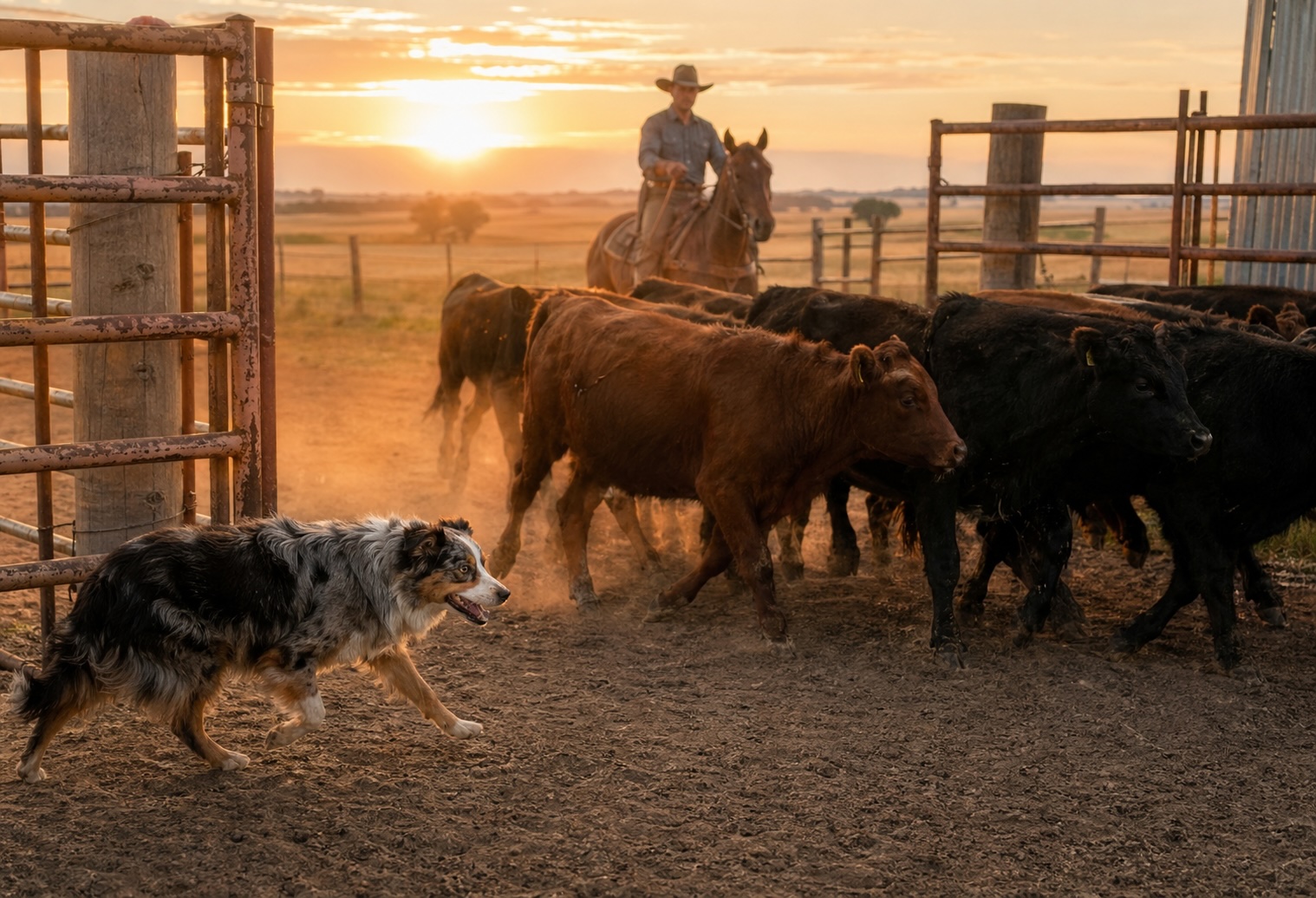
Cattle work is where a dog's grit gets tested in a hurry. A serious cow dog needs enough eye and sense to control movement, but it also needs the confidence to step in when a cow pins her ears, turns broadside, or decides the dog is too close for comfort. Many Australian Shepherds have the courage for cattle, especially those from strong working lines, but they often work differently than heavier, more forceful dogs.
A good Aussie on cattle tends to use intelligence and timing rather than brute confrontation. It may heel when needed, bark with purpose, or dart in and out to keep pressure on a stubborn bunch. In pens, alleys, and sorting setups, that nimble style can be a real advantage. The dog can slip around pressure points, avoid a kick, and keep stock moving without creating unnecessary chaos. That said, some rough cattle can wear down a softer dog, and this is where breeding and experience matter. Ranchers who need a steady cattle hand should look for proven working parents, not just breed labels.
Handling Sheep
With sheep, Australian Shepherds can be especially handy. They are often close-working, alert, and responsive enough to manage stock in tighter quarters or around facilities where precision matters. Their style can be upright compared to some other herding breeds, but that does not stop a good one from handling sheep effectively. In fact, for many small farms and mixed operations, the Aussie's ability to move from sheep pens to larger pasture chores without missing a beat is part of its appeal.
I have always liked a dog that can take the edge off flighty sheep without blowing them apart. A settled Aussie that understands pace can do just that. It does not need to manufacture excitement. It just needs to hold the right pressure and keep thinking.
Mixed Ranch Work
On many ranches, a dog is not hired for one species or one textbook task. It is expected to help wherever help is needed. This is where Australian Shepherds often earn their keep. They can gather a small bunch, load stock, help during calving season, push escapees out of the hay yard, and accompany a rider through a day full of small jobs that never make it into training manuals. Versatility is not a glamorous trait, but it is one of the most practical qualities a ranch dog can have.
Australian Shepherds are famous for intelligence, but intelligence by itself is not enough. On a ranch, a useful dog needs steadiness. It needs to accept correction, retain lessons, and keep its head when livestock get sticky and people get tired. Most Aussies learn quickly, though that speed cuts both ways. They pick up good habits fast, and bad ones even faster.
A young Aussie that discovers it can grip out of frustration, slice in too tight, or chase for the thrill of it can become a real nuisance if the handler does not step in early. Clear boundaries matter. So does giving the dog honest work. This breed is not built for a life of constant confinement with a little ball throwing on weekends. A working-minded Australian Shepherd needs structure, purpose, and regular mental engagement. Without it, that famous intelligence can turn into noise, spinning, destructive behavior, or pushy habits around stock and people.
When trained well, though, the breed is deeply satisfying to handle. There is a feeling some good Aussies give you, like they are already halfway into your thought before you finish the cue. In ranch work, that kind of connection saves time and steps. It also builds trust, and trust matters when you send a dog to gather stock you cannot fully see.
What to Look for in a Working Australian Shepherd
If ranch work is the goal, start with bloodlines that have actually done ranch work. That may sound obvious, but too many buyers get distracted by markings, size, or registration alone. A true working Australian Shepherd should come from stock selected for stock sense, sound nerves, athletic ability, and durability. Good feet, a balanced frame, and a practical coat matter more than eye color ever will.
Temperament should be a major consideration. A ranch dog can be intense without being frantic, bold without being reckless, and biddable without being weak. Puppies show hints, but mature relatives tell the real story. Watch parents if you can. Ask how they handle pressure, strange environments, and long days. Ask what kind of stock they have worked and whether they can settle quietly when the work is over. A dog that cannot turn off can be as difficult to live with as one that will not turn on.
Are Australian Shepherds the Right Ranch Dog for Every Owner?
The honest answer is no. They are excellent working dogs in the right setting, but they are not magic. Some owners want the look and legend of an Aussie without the daily commitment such a dog requires. Others assume any herding breed can naturally manage cattle or sheep with minimal guidance. That is not how ranch dogs are made.
An Australian Shepherd is often best suited to owners who value a close-working, highly interactive dog and are willing to spend time building skills. On small ranches, family operations, and mixed-stock places, they can be outstanding. On operations that demand relentless pressure on large, hard cattle in rough country every day, some individuals may thrive while others may come up short. The breed's strength lies in versatility and partnership, not in fitting every possible job the exact same way.
For many dog owners interested in herding dogs, that versatility is precisely the draw. An Aussie can work, travel, live closely with the family, and still be ready when the gate swings open and the stock need moving. That is a valuable combination, especially for people who want a dog that does more than sit on the porch looking pretty.
Final Thoughts on Australian Shepherds and Ranch Work
Australian Shepherds have held onto their place in ranch work because the good ones keep proving themselves where it counts: in dust, noise, weather, and livestock pressure. They are not all style, and they are not all instinct. The best of them blend intelligence, heart, and practical usefulness into one hard-working package.
If you are considering an Australian Shepherd for ranch work, think less about image and more about purpose. Look for working heritage, sound temperament, and a dog with enough grit to stay honest when livestock challenge it. Give that dog real training, regular work, and fair handling. Do that, and an Aussie can become the kind of ranch partner that makes chores lighter and long days better. Out in the pasture, where excuses do not amount to much, that is about the highest praise a dog can earn.
For dog owners interested in herding breeds, the Australian Shepherd remains one of the most appealing choices. The breed is athletic, highly trainable, deeply connected to its people, and versatile enough to handle a range of daily stock chores. Still, not every Aussie is cut out for serious ranch duty, and not every ranch job suits an Aussie in the same way. To understand where this breed truly shines, you have to look past the image and study the work.
What Makes Australian Shepherds Valuable on a Ranch
The best Australian Shepherds bring a blend of traits that ranchers appreciate every day: brains, balance, toughness, and adaptability. They tend to be natural problem solvers. A good Aussie does not just run hard for the sake of motion. It watches pressure, reads stock, and adjusts on the fly. That matters when livestock do something unexpected, which is to say, almost always.
On a working ranch, there is seldom one clean, choreographed outrun followed by a perfect drive across an open field. More often, the dog is asked to gather cattle out of broken country, push yearlings through a gate that suddenly became suspicious, hold pressure in an alley, or help separate ewes from lambs without turning the whole place upside down. Australian Shepherds often excel in these close-to-medium range jobs because they are quick-minded and responsive. They can work stock one minute and switch gears the next, paying close attention to the handler.
That natural attentiveness is one reason the breed has remained useful. An Aussie often wants to work with you, not merely near you. On horseback, on foot, or from the back of a side-by-side, that cooperation can make everyday ranch work smoother. When a dog understands your timing and your habits, the whole operation starts to feel more efficient.
Australian Shepherds With Cattle, Sheep, and Mixed Ranch Duties
Working Cattle
Cattle work is where a dog's grit gets tested in a hurry. A serious cow dog needs enough eye and sense to control movement, but it also needs the confidence to step in when a cow pins her ears, turns broadside, or decides the dog is too close for comfort. Many Australian Shepherds have the courage for cattle, especially those from strong working lines, but they often work differently than heavier, more forceful dogs.
A good Aussie on cattle tends to use intelligence and timing rather than brute confrontation. It may heel when needed, bark with purpose, or dart in and out to keep pressure on a stubborn bunch. In pens, alleys, and sorting setups, that nimble style can be a real advantage. The dog can slip around pressure points, avoid a kick, and keep stock moving without creating unnecessary chaos. That said, some rough cattle can wear down a softer dog, and this is where breeding and experience matter. Ranchers who need a steady cattle hand should look for proven working parents, not just breed labels.
Handling Sheep
With sheep, Australian Shepherds can be especially handy. They are often close-working, alert, and responsive enough to manage stock in tighter quarters or around facilities where precision matters. Their style can be upright compared to some other herding breeds, but that does not stop a good one from handling sheep effectively. In fact, for many small farms and mixed operations, the Aussie's ability to move from sheep pens to larger pasture chores without missing a beat is part of its appeal.
I have always liked a dog that can take the edge off flighty sheep without blowing them apart. A settled Aussie that understands pace can do just that. It does not need to manufacture excitement. It just needs to hold the right pressure and keep thinking.
Mixed Ranch Work
On many ranches, a dog is not hired for one species or one textbook task. It is expected to help wherever help is needed. This is where Australian Shepherds often earn their keep. They can gather a small bunch, load stock, help during calving season, push escapees out of the hay yard, and accompany a rider through a day full of small jobs that never make it into training manuals. Versatility is not a glamorous trait, but it is one of the most practical qualities a ranch dog can have.
Temperament and Trainability in Real Ranch Conditions
Australian Shepherds are famous for intelligence, but intelligence by itself is not enough. On a ranch, a useful dog needs steadiness. It needs to accept correction, retain lessons, and keep its head when livestock get sticky and people get tired. Most Aussies learn quickly, though that speed cuts both ways. They pick up good habits fast, and bad ones even faster.
A young Aussie that discovers it can grip out of frustration, slice in too tight, or chase for the thrill of it can become a real nuisance if the handler does not step in early. Clear boundaries matter. So does giving the dog honest work. This breed is not built for a life of constant confinement with a little ball throwing on weekends. A working-minded Australian Shepherd needs structure, purpose, and regular mental engagement. Without it, that famous intelligence can turn into noise, spinning, destructive behavior, or pushy habits around stock and people.
When trained well, though, the breed is deeply satisfying to handle. There is a feeling some good Aussies give you, like they are already halfway into your thought before you finish the cue. In ranch work, that kind of connection saves time and steps. It also builds trust, and trust matters when you send a dog to gather stock you cannot fully see.
What to Look for in a Working Australian Shepherd
If ranch work is the goal, start with bloodlines that have actually done ranch work. That may sound obvious, but too many buyers get distracted by markings, size, or registration alone. A true working Australian Shepherd should come from stock selected for stock sense, sound nerves, athletic ability, and durability. Good feet, a balanced frame, and a practical coat matter more than eye color ever will.
Temperament should be a major consideration. A ranch dog can be intense without being frantic, bold without being reckless, and biddable without being weak. Puppies show hints, but mature relatives tell the real story. Watch parents if you can. Ask how they handle pressure, strange environments, and long days. Ask what kind of stock they have worked and whether they can settle quietly when the work is over. A dog that cannot turn off can be as difficult to live with as one that will not turn on.
Are Australian Shepherds the Right Ranch Dog for Every Owner?
The honest answer is no. They are excellent working dogs in the right setting, but they are not magic. Some owners want the look and legend of an Aussie without the daily commitment such a dog requires. Others assume any herding breed can naturally manage cattle or sheep with minimal guidance. That is not how ranch dogs are made.
An Australian Shepherd is often best suited to owners who value a close-working, highly interactive dog and are willing to spend time building skills. On small ranches, family operations, and mixed-stock places, they can be outstanding. On operations that demand relentless pressure on large, hard cattle in rough country every day, some individuals may thrive while others may come up short. The breed's strength lies in versatility and partnership, not in fitting every possible job the exact same way.
For many dog owners interested in herding dogs, that versatility is precisely the draw. An Aussie can work, travel, live closely with the family, and still be ready when the gate swings open and the stock need moving. That is a valuable combination, especially for people who want a dog that does more than sit on the porch looking pretty.
Final Thoughts on Australian Shepherds and Ranch Work
Australian Shepherds have held onto their place in ranch work because the good ones keep proving themselves where it counts: in dust, noise, weather, and livestock pressure. They are not all style, and they are not all instinct. The best of them blend intelligence, heart, and practical usefulness into one hard-working package.
If you are considering an Australian Shepherd for ranch work, think less about image and more about purpose. Look for working heritage, sound temperament, and a dog with enough grit to stay honest when livestock challenge it. Give that dog real training, regular work, and fair handling. Do that, and an Aussie can become the kind of ranch partner that makes chores lighter and long days better. Out in the pasture, where excuses do not amount to much, that is about the highest praise a dog can earn.


View all 0 comments