Managing Multiple Working Dogs on a Farm
Building Order, Drive, and Trust
Jeff Davis | https://herdingdogcentral.com
 0
0 0
0 0
0 0
0 0
0
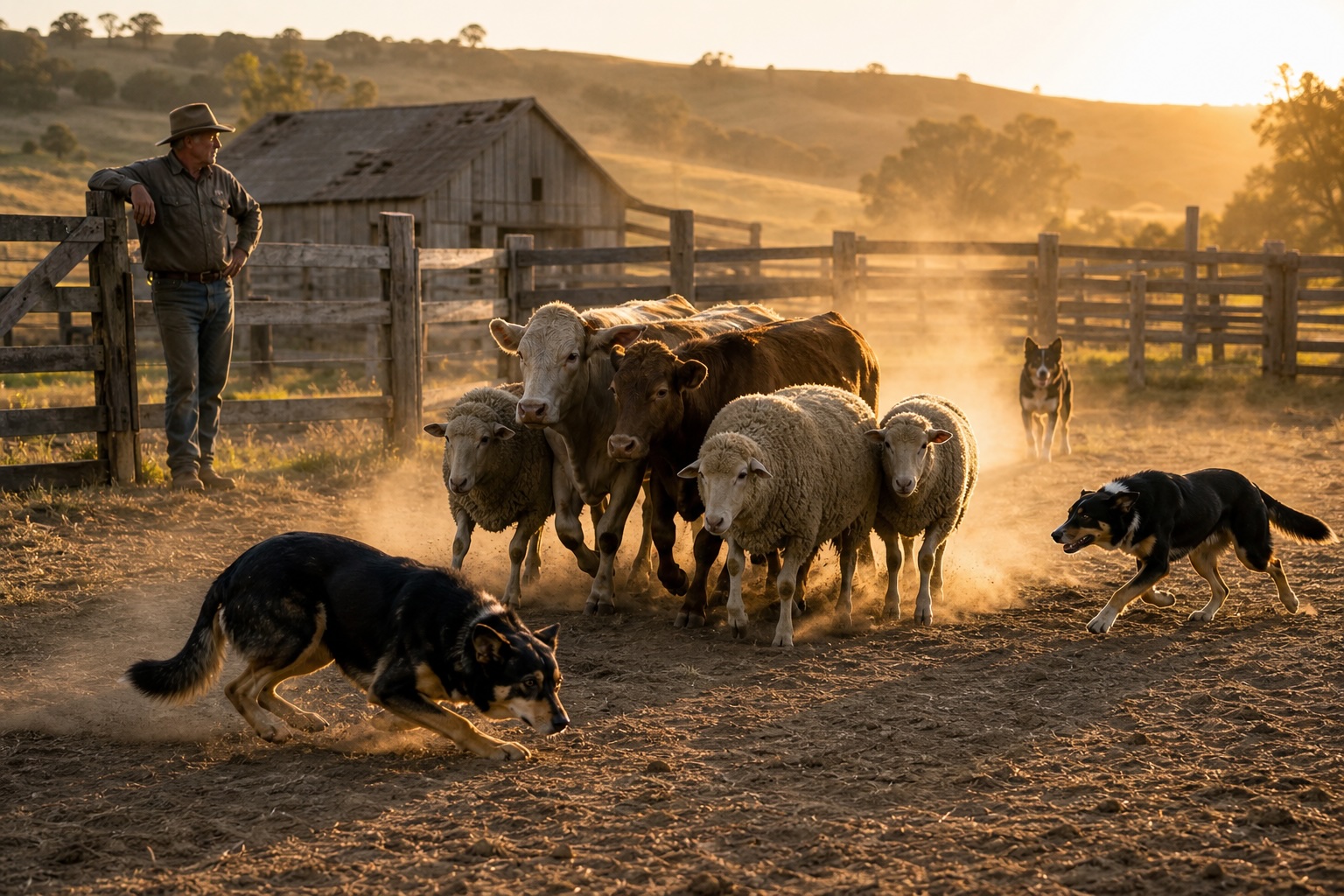
Managing multiple working dogs on a farm looks romantic from a distance. Folks imagine a tidy string of sharp-eyed dogs waiting at the gate, each one ready to gather stock, push cattle through a lane, or bark at the right moment and then settle when the work is done. In real life, it is a little dustier than that. It takes planning, repetition, and a clear head. When you have several dogs with different ages, drives, and jobs, you are not just handling animals. You are running a team, and a team without structure will find a way to make its own.
I have seen farms where two good dogs did the work of five because they were managed well, and I have seen places where five capable dogs burned up energy, stirred stock, and wore out their owner because nobody had laid down a system. The difference usually comes down to routine, fairness, and understanding what each dog is built to do. If you want to succeed with multiple working dogs on a farm, you need more than obedience. You need management that fits the land, the livestock, and the temperament of every dog in the yard.
Start with roles, not numbers
The first mistake many owners make is thinking in terms of how many dogs they have rather than what each dog is responsible for. One dog may be steady and level-headed with sheep, another may have the power to move stubborn cattle, and a younger dog may still be learning how to think before it reacts. If all three are treated the same, you end up creating confusion in the dogs and frustration in yourself.
Good farm dog management begins by assigning clear roles. There should be dogs that work regularly, dogs that are in training, dogs that are resting, and dogs that may only come out for certain stock or certain weather conditions. That sounds simple, but it changes everything. Once a dog has a defined place in the rotation, it stops competing for every job. It learns patience, and you start making cleaner decisions in the moment.
On a cold morning, when cattle are tight in the lot and steam is rolling off their backs, that is no time to wonder which dog can handle pressure. You should already know. The dog you send first needs to be the one that can take the edge off the herd without lighting a fuse. A second dog may be useful on the flank or as backup through a gate, but only if both dogs understand their jobs and do not crowd each other.
Build a routine the dogs can trust
Dogs that work livestock thrive on rhythm. They notice feeding times, kennel order, truck rides, and the difference between a training session and a real job. When you keep a dependable routine, your dogs settle faster and waste less energy. When every day is unpredictable, the high-drive dogs stay amped up, the softer dogs get pushed aside, and kennel noise tends to rise.
Feeding, turnout, work sessions, and rest should happen in an order your dogs can count on. That does not mean every day must look identical. Farm life rarely allows that. It does mean there should be a recognizable pattern. A dog that knows its turn is coming is much easier to manage than one that believes it must scream, paw the gate, or challenge another dog to get noticed.
I prefer a system where dogs are brought out one at a time unless a job specifically calls for a pair. That keeps anticipation from spilling over into foolishness. It also lets you read each dog before the work starts. You can tell a lot from how a dog comes out of the kennel. A dog that walks out balanced and attentive is ready. A dog that blows out like a bottle rocket may need a minute to settle before it sees stock.
Why kennel order matters
Kennel management is not glamorous, but it is one of the foundations of controlling multiple working dogs. Dogs that live too close without boundaries can develop fence running, nonstop barking, and hard-eyed tension that follows them into the field. A clean kennel, visual barriers where needed, and deliberate kennel placement can prevent many problems before training ever enters the picture.
Older, reliable dogs often do better if they are housed where they can rest without being pestered by younger dogs. High-drive dogs may need separation from rivals. Youngsters benefit from seeing calm adults, but not from being allowed to rehearse frantic behavior all day. The kennel should support the work, not sabotage it.
Train individually before expecting teamwork
One of the surest ways to make a mess is to run dogs together before they are solid alone. A dog that does not stop, recall, hold pressure, or give space on its own will not magically improve because another dog is present. More often, the dogs feed off each other and magnify every weak spot. That is when stock gets rushed, commands get ignored, and the owner starts hollering louder than necessary.
Each working dog on a farm needs a dependable foundation. That includes recall, a stop or down, directional control, patience around gates, and the ability to disengage when asked. Once those basics are honest, then you can begin introducing paired work in carefully chosen situations. Start with simple tasks, not high-pressure jobs. Let one experienced dog steady the picture while the second dog learns where it fits.
There is a real art to knowing which dogs should work together. Two hard-charging dogs may compete and split the stock. Two soft dogs may hesitate and leave holes. Often the best pairing is not the two strongest workers, but the two dogs whose styles complement one another. One may gather cleanly while the other holds a gate with quiet authority. Good teamwork in dogs looks almost effortless, but it is built through repetition and restraint.
Correct less, set up better
When handling multiple dogs, setup matters more than force. If you constantly have to correct barking, slicing in, crowding, or stealing another dog's job, step back and look at the picture you created. Were the dogs too fresh? Was the stock too light? Did you bring out an immature dog with one that would trigger competition? Strong handling has its place, but thoughtful setup prevents many avoidable conflicts.
The best handlers I have watched were quiet. They did not say much, and they did not waste motion. Their dogs understood the rules before pressure hit. That kind of control comes from consistency, not drama.
Manage drive so it stays useful
Drive is a gift on a farm, but unmanaged drive can wear a place out. A good working dog should want the job, yet it also needs an off switch. When you have several dogs, that off switch becomes even more important because excitement spreads fast. One barking dog can set off the whole yard. One rough outrun can tighten stock and trigger the next dog to come in hotter than it should.
This is where rest becomes part of training. Not every keen dog needs more work. Some need more waiting. A dog that learns to watch another dog work without melting down is becoming more useful, not less. Patience is a working skill. So is settling in the truck, lying quietly near the pens, and standing tied without fuss while another dog takes a turn.
Conditioning matters too. Farm dogs that are under-exercised often come into work with too much edge. Farm dogs that are overworked can get sharp, irritable, and mentally stale. A balanced program includes real jobs, short tune-up sessions, free movement, and enough downtime for the dog to recover both physically and mentally.
Reduce conflict around food, space, and attention
Most trouble between working dogs does not begin in the field. It starts in the kennel run, at feeding time, around the truck tailgate, or beside the owner's leg. Multi-dog farms need rules in these ordinary places. Feed separately if there is any tension. Load and unload in an established order. Do not let pushy dogs claim every doorway or every greeting. Small acts of unfairness add up, and dogs notice.
Attention can become a resource just like food. A favored dog that crowds you and drives others off can quietly sour the whole group dynamic. That does not mean every dog must be treated as if it were identical. Working dogs are individuals. It does mean respect should be enforced across the board. No dog should be allowed to bully another away from water, shade, the truck, or the handler.
Older dogs deserve protection here. The seasoned dog that has done years of honest work should not have to fend off every young hotshot in the kennel yard. If you value your veterans, manage the environment so they can rest and continue teaching by example rather than constantly defending themselves.
Know when to leave a dog home
One of the marks of a mature handler is the willingness to leave a dog out of the job. Just because a dog can work does not mean it should be on every task. Some dogs become better when they are not overused. Others are excellent in one type of stock work and poor in another. There is no shame in that. The goal is not to prove that every dog can do everything. The goal is to get the work done cleanly and keep your dogs useful for years.
I have known dogs that were gold in open fields and trouble in tight pens. Others could sort in a cramped alley all day but got too loose and casual on a big gather. A smart farm owner respects those differences. You build a stronger team when you stop trying to force every dog into the same shape.
Good management creates better dogs
Managing multiple working dogs on a farm is really about creating order the dogs can understand. Clear roles, dependable routines, individual training, controlled pair work, and fair kennel management all feed into that order. Once the dogs trust the structure, their natural ability has room to show itself. They stop wasting effort on each other and start giving more of themselves to the livestock and the handler.
There is satisfaction in watching a well-managed team go to work. A gate opens, one dog slips out with purpose, another waits without complaint, and the stock begins to flow where it should. Nothing flashy, nothing loud, just steady work done right. That kind of farm dog operation is not built in a week, and it is not built by chance. It comes from paying attention every day to the little things most folks overlook.
If you own herding dogs and plan to keep more than one in service, remember this: your management will either sharpen their instincts or scatter them. Farm dogs rise to the level of the system around them. Give them clarity, fairness, and honest work, and most of them will meet you there.
I have seen farms where two good dogs did the work of five because they were managed well, and I have seen places where five capable dogs burned up energy, stirred stock, and wore out their owner because nobody had laid down a system. The difference usually comes down to routine, fairness, and understanding what each dog is built to do. If you want to succeed with multiple working dogs on a farm, you need more than obedience. You need management that fits the land, the livestock, and the temperament of every dog in the yard.
Start with roles, not numbers
The first mistake many owners make is thinking in terms of how many dogs they have rather than what each dog is responsible for. One dog may be steady and level-headed with sheep, another may have the power to move stubborn cattle, and a younger dog may still be learning how to think before it reacts. If all three are treated the same, you end up creating confusion in the dogs and frustration in yourself.
Good farm dog management begins by assigning clear roles. There should be dogs that work regularly, dogs that are in training, dogs that are resting, and dogs that may only come out for certain stock or certain weather conditions. That sounds simple, but it changes everything. Once a dog has a defined place in the rotation, it stops competing for every job. It learns patience, and you start making cleaner decisions in the moment.
On a cold morning, when cattle are tight in the lot and steam is rolling off their backs, that is no time to wonder which dog can handle pressure. You should already know. The dog you send first needs to be the one that can take the edge off the herd without lighting a fuse. A second dog may be useful on the flank or as backup through a gate, but only if both dogs understand their jobs and do not crowd each other.
Build a routine the dogs can trust
Dogs that work livestock thrive on rhythm. They notice feeding times, kennel order, truck rides, and the difference between a training session and a real job. When you keep a dependable routine, your dogs settle faster and waste less energy. When every day is unpredictable, the high-drive dogs stay amped up, the softer dogs get pushed aside, and kennel noise tends to rise.
Feeding, turnout, work sessions, and rest should happen in an order your dogs can count on. That does not mean every day must look identical. Farm life rarely allows that. It does mean there should be a recognizable pattern. A dog that knows its turn is coming is much easier to manage than one that believes it must scream, paw the gate, or challenge another dog to get noticed.
I prefer a system where dogs are brought out one at a time unless a job specifically calls for a pair. That keeps anticipation from spilling over into foolishness. It also lets you read each dog before the work starts. You can tell a lot from how a dog comes out of the kennel. A dog that walks out balanced and attentive is ready. A dog that blows out like a bottle rocket may need a minute to settle before it sees stock.
Why kennel order matters
Kennel management is not glamorous, but it is one of the foundations of controlling multiple working dogs. Dogs that live too close without boundaries can develop fence running, nonstop barking, and hard-eyed tension that follows them into the field. A clean kennel, visual barriers where needed, and deliberate kennel placement can prevent many problems before training ever enters the picture.
Older, reliable dogs often do better if they are housed where they can rest without being pestered by younger dogs. High-drive dogs may need separation from rivals. Youngsters benefit from seeing calm adults, but not from being allowed to rehearse frantic behavior all day. The kennel should support the work, not sabotage it.
Train individually before expecting teamwork
One of the surest ways to make a mess is to run dogs together before they are solid alone. A dog that does not stop, recall, hold pressure, or give space on its own will not magically improve because another dog is present. More often, the dogs feed off each other and magnify every weak spot. That is when stock gets rushed, commands get ignored, and the owner starts hollering louder than necessary.
Each working dog on a farm needs a dependable foundation. That includes recall, a stop or down, directional control, patience around gates, and the ability to disengage when asked. Once those basics are honest, then you can begin introducing paired work in carefully chosen situations. Start with simple tasks, not high-pressure jobs. Let one experienced dog steady the picture while the second dog learns where it fits.
There is a real art to knowing which dogs should work together. Two hard-charging dogs may compete and split the stock. Two soft dogs may hesitate and leave holes. Often the best pairing is not the two strongest workers, but the two dogs whose styles complement one another. One may gather cleanly while the other holds a gate with quiet authority. Good teamwork in dogs looks almost effortless, but it is built through repetition and restraint.
Correct less, set up better
When handling multiple dogs, setup matters more than force. If you constantly have to correct barking, slicing in, crowding, or stealing another dog's job, step back and look at the picture you created. Were the dogs too fresh? Was the stock too light? Did you bring out an immature dog with one that would trigger competition? Strong handling has its place, but thoughtful setup prevents many avoidable conflicts.
The best handlers I have watched were quiet. They did not say much, and they did not waste motion. Their dogs understood the rules before pressure hit. That kind of control comes from consistency, not drama.
Manage drive so it stays useful
Drive is a gift on a farm, but unmanaged drive can wear a place out. A good working dog should want the job, yet it also needs an off switch. When you have several dogs, that off switch becomes even more important because excitement spreads fast. One barking dog can set off the whole yard. One rough outrun can tighten stock and trigger the next dog to come in hotter than it should.
This is where rest becomes part of training. Not every keen dog needs more work. Some need more waiting. A dog that learns to watch another dog work without melting down is becoming more useful, not less. Patience is a working skill. So is settling in the truck, lying quietly near the pens, and standing tied without fuss while another dog takes a turn.
Conditioning matters too. Farm dogs that are under-exercised often come into work with too much edge. Farm dogs that are overworked can get sharp, irritable, and mentally stale. A balanced program includes real jobs, short tune-up sessions, free movement, and enough downtime for the dog to recover both physically and mentally.
Reduce conflict around food, space, and attention
Most trouble between working dogs does not begin in the field. It starts in the kennel run, at feeding time, around the truck tailgate, or beside the owner's leg. Multi-dog farms need rules in these ordinary places. Feed separately if there is any tension. Load and unload in an established order. Do not let pushy dogs claim every doorway or every greeting. Small acts of unfairness add up, and dogs notice.
Attention can become a resource just like food. A favored dog that crowds you and drives others off can quietly sour the whole group dynamic. That does not mean every dog must be treated as if it were identical. Working dogs are individuals. It does mean respect should be enforced across the board. No dog should be allowed to bully another away from water, shade, the truck, or the handler.
Older dogs deserve protection here. The seasoned dog that has done years of honest work should not have to fend off every young hotshot in the kennel yard. If you value your veterans, manage the environment so they can rest and continue teaching by example rather than constantly defending themselves.
Know when to leave a dog home
One of the marks of a mature handler is the willingness to leave a dog out of the job. Just because a dog can work does not mean it should be on every task. Some dogs become better when they are not overused. Others are excellent in one type of stock work and poor in another. There is no shame in that. The goal is not to prove that every dog can do everything. The goal is to get the work done cleanly and keep your dogs useful for years.
I have known dogs that were gold in open fields and trouble in tight pens. Others could sort in a cramped alley all day but got too loose and casual on a big gather. A smart farm owner respects those differences. You build a stronger team when you stop trying to force every dog into the same shape.
Good management creates better dogs
Managing multiple working dogs on a farm is really about creating order the dogs can understand. Clear roles, dependable routines, individual training, controlled pair work, and fair kennel management all feed into that order. Once the dogs trust the structure, their natural ability has room to show itself. They stop wasting effort on each other and start giving more of themselves to the livestock and the handler.
There is satisfaction in watching a well-managed team go to work. A gate opens, one dog slips out with purpose, another waits without complaint, and the stock begins to flow where it should. Nothing flashy, nothing loud, just steady work done right. That kind of farm dog operation is not built in a week, and it is not built by chance. It comes from paying attention every day to the little things most folks overlook.
If you own herding dogs and plan to keep more than one in service, remember this: your management will either sharpen their instincts or scatter them. Farm dogs rise to the level of the system around them. Give them clarity, fairness, and honest work, and most of them will meet you there.