How Many Guard Dogs a Farm Needs
Jeff Davis | https://herdingdogcentral.com
 0
0 0
0 0
0 0
0 0
0
If you spend enough seasons around livestock, you learn pretty quickly that the question is not simply whether a farm needs a guard dog. The real question is how many guard dogs a farm needs to do the job well without creating new problems. I have seen small places where one solid dog handled the night watch just fine, and I have seen bigger, rougher country where two or three were the difference between sleeping easy and finding a mess in the pasture at daylight.
Folks often hope there is a neat formula. There usually is not. A ten-acre hobby farm with a tight fence line, close neighbors, and a handful of goats plays by different rules than a hundred-acre spread bordered by timber and coyote travel lanes. The number of dogs you need comes down to pressure, not pride. Too few dogs leave gaps. Too many can lead to territorial friction, wasted feed, management headaches, and dogs that spend more time sorting each other out than guarding stock.
Start With the Livestock, Not the Dog Count
The first place to begin is with the animals you are trying to protect. Sheep and goats tend to draw more predator attention than mature cattle, and poultry can tempt every thief in the county, feathered or furred. Calves, lambs, and kids also shift the equation, because birthing season attracts trouble. A farm with twenty ewes and lambs may need tighter protection than a place with twice the acreage and a herd of seasoned cattle.
In my experience, a single well-bonded livestock guardian dog can cover a small, secure farm with low predator pressure. That usually means modest acreage, reliable fencing, stock grouped in manageable areas, and predators that pass through more than they hunt hard. One dog can stay with the animals, bark off nuisance visitors, and hold a line at night if the setting is in its favor.
Once your farm expands in size or your livestock is split into separate pastures, one dog starts running out of reach. Dogs are flesh and blood, not fence posts. They cannot be on both ends of the property at once, and predators learn patterns fast. If you have multiple groups of animals or a layout broken by woods, draws, gullies, or outbuildings, the need for a second dog often becomes clear.
Predator Pressure Decides More Than Acreage
Acreage matters, but predator pressure matters more. I would rather turn one good dog loose on forty open acres with decent visibility than ask that same dog to protect fifteen brushy acres crawling with coyotes, stray dogs, raccoons, and the occasional bobcat. The country itself tells you a lot. If you hear coyotes every night, find tracks near the barn, or have already taken losses, that is your answer talking.
For low-pressure farms, one dog may be enough. For moderate pressure, two dogs are often the sweet spot. They work better as a team, especially after dark. One dog may stay close with the stock while the other moves out to challenge, patrol, and create uncertainty for predators. That partnership matters more than many beginners realize. A lone dog has to choose between staying put and pushing out. Two dogs can do both.
In high-pressure country, especially where wolves, feral dogs, mountain lions, or organized coyote packs are a real concern, three or more dogs may be justified. That is not about drama. It is about numbers, endurance, and confidence. Predators test weak points. A team of dogs presents a harder target and keeps watch rotating naturally through the night. Still, adding dogs should be done for a reason, not because more sounds safer on paper.
When Two Dogs Make the Most Sense
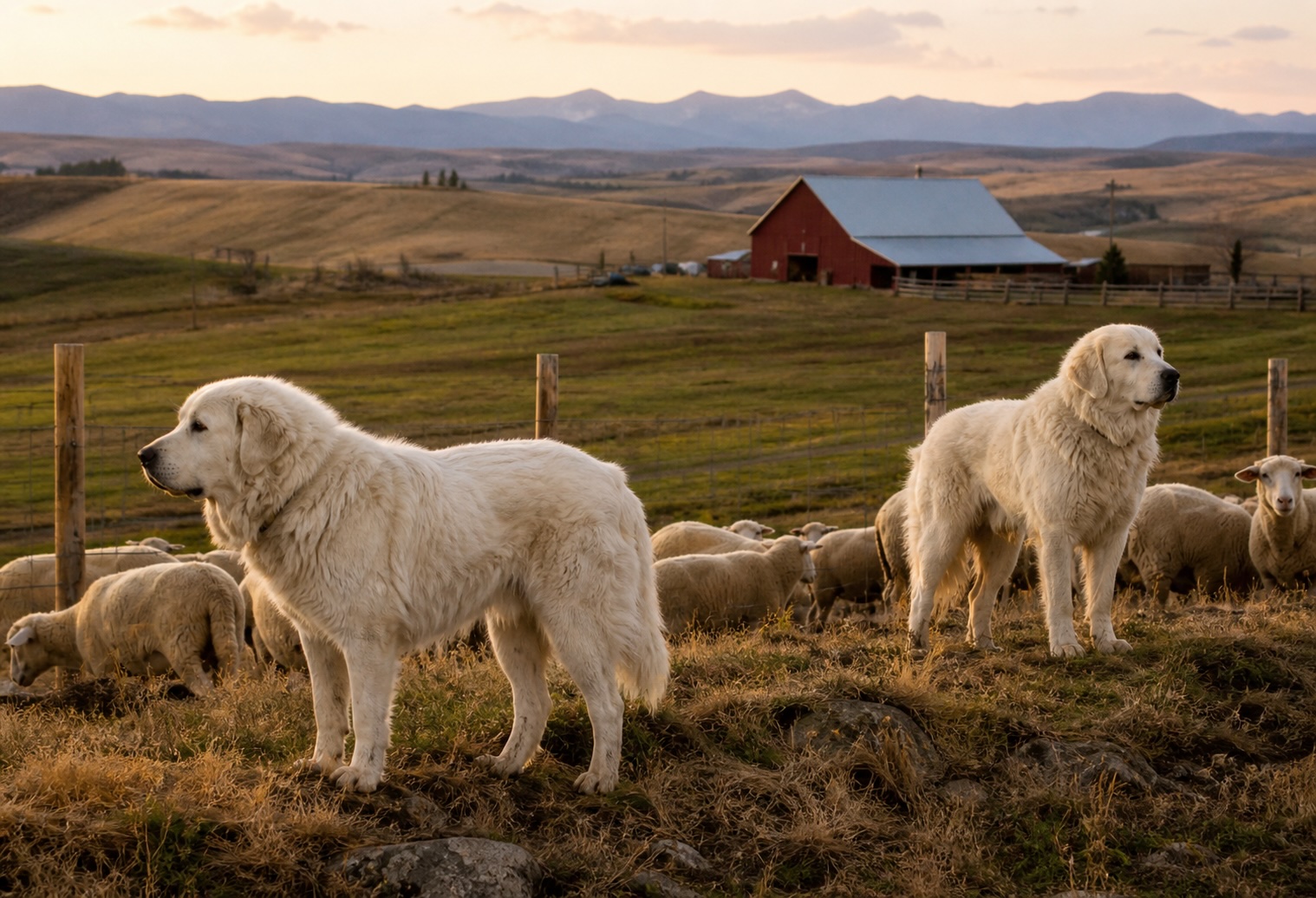
If I had to name the most practical setup for many working farms, it would be two compatible guard dogs. Two dogs can back each other up, cover more ground, and handle pressure without getting worn down as quickly. If one is tied up watching a disturbance on one side of the pasture, the other remains with the livestock. If one gets injured or sick, you are not left entirely exposed. That kind of redundancy is worth plenty during lambing or kidding season.
Two dogs also tend to mature better in many cases. A young dog learns steadiness from an older, reliable partner. I have watched green dogs settle into their role faster when they had a seasoned animal to model. That only works when the older dog is sound in temperament and truly bonded to stock, but when it works, it saves a lot of frustration.
Terrain, Fencing, and Farm Layout Matter
Open pasture is one thing. Broken ground is another. Thick cedar, creek bottoms, blind corners, rocky ridges, and scattered outbuildings all create hiding spots and routes of approach. The rougher and more chopped up your property is, the more likely you are to need an extra dog. Not because the acreage is bigger, but because the coverage is poorer.
Good fencing reduces the burden on the dogs. It does not replace them, but it helps them hold a boundary. Weak fencing does the opposite. It invites roaming, leaves stock vulnerable, and causes dogs to spend energy where they should not. If your guardian dogs are constantly patrolling the road or squaring off with the neighbor's pets through a broken line, your system is already under strain.
Another point many people miss is stock grouping. If all your vulnerable animals come in at night to a secure lot or are rotated into tighter paddocks, fewer dogs may be needed than if your livestock is scattered over large areas around the clock. Guarding concentrated stock is easier than guarding livestock stretched thin across a place.
How Many Guard Dogs for Common Farm Setups
For a small farm with a single herd or flock, strong fencing, and light predator pressure, one proven dog may be enough. That is often true for modest goat or sheep operations where the owner is present daily and stock are locked up or brought closer to the house at night. One dog can do excellent work when the farm supports that setup.
For medium-sized farms with multiple pastures, regular predator traffic, or vulnerable young stock, two dogs are often the practical minimum. This is the setup I recommend most often because it balances coverage, companionship, and real-world resilience. Two good dogs can handle a lot if they are mature, bonded, and managed correctly.
For larger operations, remote grazing, or areas with serious predator conflict, three dogs may be warranted, sometimes more if stock are divided into separate groups. At that point, though, you are building a working system, not just adding protection. Feeding, veterinary care, introductions, breeding control, and territorial behavior all have to be managed with a steady hand.
Do Not Confuse Herding Dogs With Guard Dogs
Since this is a topic for folks interested in herding dogs, it is worth saying plainly that a herding dog and a livestock guardian dog do not do the same job. A Border Collie, Australian Shepherd, or other herding breed may be sharp, loyal, and alert, but that does not make it a true guardian in the pasture. Herding dogs work with you. Guardian dogs work with the stock. There can be overlap in awareness and farm usefulness, but the instincts are different.
I have seen good herding dogs sound the alarm and help stir the yard when something feels off, but I would not ask most of them to stand alone against determined predators through the night. If your farm uses both herding and guardian dogs, each needs a clear role. That arrangement can be excellent when managed right, especially on working sheep and goat places, but it still does not change the count needed for actual livestock protection.
The Hidden Cost of Too Many Dogs
People rarely ask if they can have too many guard dogs, but they can. Extra dogs mean more feed, more vet bills, more wear on fencing, and more chances for dominance disputes or nuisance barking. Some farms become noisy, chaotic, and difficult to manage simply because the owner kept adding dogs instead of fixing weak fencing, poor stock placement, or inconsistent training.
A mismatched group can also create bonding problems. Dogs that bond more strongly with each other than with the stock may drift, play, roam, or become less attentive. That defeats the purpose. The goal is not a pack in the romantic sense. The goal is calm, reliable protection tailored to the property.
So, How Many Guard Dogs Does a Farm Need?
For many farms, the honest answer is one to two. One dog may be enough for a smaller, secure place with light pressure. Two dogs are often ideal for farms with sheep, goats, mixed terrain, and regular predator activity. Three or more usually comes into play on larger properties, split grazing systems, or in areas where predator threats are serious and persistent.
If you are on the fence, I generally favor starting with one excellent dog or one experienced dog paired with a carefully selected younger partner, then evaluating losses, behavior, and coverage over time. Let the farm tell you what it needs. Watch the stock. Watch the fence lines. Listen at night. The right number is the one that protects your animals consistently without making the place harder to run.
At the end of it, good livestock protection is never just about dog count. It is about matching the dogs to the land, the stock, and the kind of pressure your farm actually faces. The best farms I have seen do not guess at it. They read the country, know their animals, and build a system that works season after season.
Folks often hope there is a neat formula. There usually is not. A ten-acre hobby farm with a tight fence line, close neighbors, and a handful of goats plays by different rules than a hundred-acre spread bordered by timber and coyote travel lanes. The number of dogs you need comes down to pressure, not pride. Too few dogs leave gaps. Too many can lead to territorial friction, wasted feed, management headaches, and dogs that spend more time sorting each other out than guarding stock.
Start With the Livestock, Not the Dog Count
The first place to begin is with the animals you are trying to protect. Sheep and goats tend to draw more predator attention than mature cattle, and poultry can tempt every thief in the county, feathered or furred. Calves, lambs, and kids also shift the equation, because birthing season attracts trouble. A farm with twenty ewes and lambs may need tighter protection than a place with twice the acreage and a herd of seasoned cattle.
In my experience, a single well-bonded livestock guardian dog can cover a small, secure farm with low predator pressure. That usually means modest acreage, reliable fencing, stock grouped in manageable areas, and predators that pass through more than they hunt hard. One dog can stay with the animals, bark off nuisance visitors, and hold a line at night if the setting is in its favor.
Once your farm expands in size or your livestock is split into separate pastures, one dog starts running out of reach. Dogs are flesh and blood, not fence posts. They cannot be on both ends of the property at once, and predators learn patterns fast. If you have multiple groups of animals or a layout broken by woods, draws, gullies, or outbuildings, the need for a second dog often becomes clear.
Predator Pressure Decides More Than Acreage
Acreage matters, but predator pressure matters more. I would rather turn one good dog loose on forty open acres with decent visibility than ask that same dog to protect fifteen brushy acres crawling with coyotes, stray dogs, raccoons, and the occasional bobcat. The country itself tells you a lot. If you hear coyotes every night, find tracks near the barn, or have already taken losses, that is your answer talking.
For low-pressure farms, one dog may be enough. For moderate pressure, two dogs are often the sweet spot. They work better as a team, especially after dark. One dog may stay close with the stock while the other moves out to challenge, patrol, and create uncertainty for predators. That partnership matters more than many beginners realize. A lone dog has to choose between staying put and pushing out. Two dogs can do both.
In high-pressure country, especially where wolves, feral dogs, mountain lions, or organized coyote packs are a real concern, three or more dogs may be justified. That is not about drama. It is about numbers, endurance, and confidence. Predators test weak points. A team of dogs presents a harder target and keeps watch rotating naturally through the night. Still, adding dogs should be done for a reason, not because more sounds safer on paper.
When Two Dogs Make the Most Sense
If I had to name the most practical setup for many working farms, it would be two compatible guard dogs. Two dogs can back each other up, cover more ground, and handle pressure without getting worn down as quickly. If one is tied up watching a disturbance on one side of the pasture, the other remains with the livestock. If one gets injured or sick, you are not left entirely exposed. That kind of redundancy is worth plenty during lambing or kidding season.
Two dogs also tend to mature better in many cases. A young dog learns steadiness from an older, reliable partner. I have watched green dogs settle into their role faster when they had a seasoned animal to model. That only works when the older dog is sound in temperament and truly bonded to stock, but when it works, it saves a lot of frustration.
Terrain, Fencing, and Farm Layout Matter
Open pasture is one thing. Broken ground is another. Thick cedar, creek bottoms, blind corners, rocky ridges, and scattered outbuildings all create hiding spots and routes of approach. The rougher and more chopped up your property is, the more likely you are to need an extra dog. Not because the acreage is bigger, but because the coverage is poorer.
Good fencing reduces the burden on the dogs. It does not replace them, but it helps them hold a boundary. Weak fencing does the opposite. It invites roaming, leaves stock vulnerable, and causes dogs to spend energy where they should not. If your guardian dogs are constantly patrolling the road or squaring off with the neighbor's pets through a broken line, your system is already under strain.
Another point many people miss is stock grouping. If all your vulnerable animals come in at night to a secure lot or are rotated into tighter paddocks, fewer dogs may be needed than if your livestock is scattered over large areas around the clock. Guarding concentrated stock is easier than guarding livestock stretched thin across a place.
How Many Guard Dogs for Common Farm Setups
For a small farm with a single herd or flock, strong fencing, and light predator pressure, one proven dog may be enough. That is often true for modest goat or sheep operations where the owner is present daily and stock are locked up or brought closer to the house at night. One dog can do excellent work when the farm supports that setup.
For medium-sized farms with multiple pastures, regular predator traffic, or vulnerable young stock, two dogs are often the practical minimum. This is the setup I recommend most often because it balances coverage, companionship, and real-world resilience. Two good dogs can handle a lot if they are mature, bonded, and managed correctly.
For larger operations, remote grazing, or areas with serious predator conflict, three dogs may be warranted, sometimes more if stock are divided into separate groups. At that point, though, you are building a working system, not just adding protection. Feeding, veterinary care, introductions, breeding control, and territorial behavior all have to be managed with a steady hand.
Do Not Confuse Herding Dogs With Guard Dogs
Since this is a topic for folks interested in herding dogs, it is worth saying plainly that a herding dog and a livestock guardian dog do not do the same job. A Border Collie, Australian Shepherd, or other herding breed may be sharp, loyal, and alert, but that does not make it a true guardian in the pasture. Herding dogs work with you. Guardian dogs work with the stock. There can be overlap in awareness and farm usefulness, but the instincts are different.
I have seen good herding dogs sound the alarm and help stir the yard when something feels off, but I would not ask most of them to stand alone against determined predators through the night. If your farm uses both herding and guardian dogs, each needs a clear role. That arrangement can be excellent when managed right, especially on working sheep and goat places, but it still does not change the count needed for actual livestock protection.
The Hidden Cost of Too Many Dogs
People rarely ask if they can have too many guard dogs, but they can. Extra dogs mean more feed, more vet bills, more wear on fencing, and more chances for dominance disputes or nuisance barking. Some farms become noisy, chaotic, and difficult to manage simply because the owner kept adding dogs instead of fixing weak fencing, poor stock placement, or inconsistent training.
A mismatched group can also create bonding problems. Dogs that bond more strongly with each other than with the stock may drift, play, roam, or become less attentive. That defeats the purpose. The goal is not a pack in the romantic sense. The goal is calm, reliable protection tailored to the property.
So, How Many Guard Dogs Does a Farm Need?
For many farms, the honest answer is one to two. One dog may be enough for a smaller, secure place with light pressure. Two dogs are often ideal for farms with sheep, goats, mixed terrain, and regular predator activity. Three or more usually comes into play on larger properties, split grazing systems, or in areas where predator threats are serious and persistent.
If you are on the fence, I generally favor starting with one excellent dog or one experienced dog paired with a carefully selected younger partner, then evaluating losses, behavior, and coverage over time. Let the farm tell you what it needs. Watch the stock. Watch the fence lines. Listen at night. The right number is the one that protects your animals consistently without making the place harder to run.
At the end of it, good livestock protection is never just about dog count. It is about matching the dogs to the land, the stock, and the kind of pressure your farm actually faces. The best farms I have seen do not guess at it. They read the country, know their animals, and build a system that works season after season.