Why Livestock Guardians Live With the Flock
Jeff Davis | https://herdingdogcentral.com
 0
0 0
0 0
0 0
0 0
0
If you spend enough time around ranches, sheep camps, and rough country where coyotes sing after dark, you learn one thing in a hurry: a good livestock guardian dog is not a kennel dog. It is not a porch ornament either. A real guardian lives with the animals, moves with them, sleeps among them, and treats them as its own responsibility. That old arrangement is not some quaint tradition handed down because folks like things the hard way. It is the foundation of how these dogs work.
For dog owners interested in herding dogs, this can be surprising at first. Herding breeds usually work in partnership with a handler, taking direction and controlling stock through pressure and movement. Livestock guardian dogs are built for a different job. Breeds like the Great Pyrenees, Anatolian Shepherd, Maremma Sheepdog, Akbash, and Komondor were developed to stay with vulnerable animals and make independent decisions day and night. They are not there to gather sheep into a gate on command. They are there to convince predators that the flock is defended every hour they are thinking about making a move.
The Bond Comes Before the Protection
The central reason livestock guardians live with the flock is simple: they protect what they believe belongs to them. That belief is not abstract. It is formed through daily contact, scent, routine, and trust. A guardian pup raised correctly around sheep or goats begins to identify those animals as its social group. It learns their sounds, their movement, their moods, and their normal patterns. Once that bond is established, the dog does not need to be told every evening to watch over them. It already feels that duty.
I have seen this difference plain as day. A dog kept apart from stock may bark at danger, may patrol a fence, and may even show some interest in guarding. But a dog that has bedded down beside lambing ewes or paced the edges of a goat pasture through cold rain carries itself differently. It notices when one animal lags behind. It reacts when the flock startles. It reads the night sounds around them as if every rustle matters, because to that dog, it does.
That deep attachment is what gives livestock guardian dogs their steadiness. They are not merely defending property lines. They are defending living animals they know.
Why Early Exposure Matters
Pups do not come out of the whelping box fully trained, but they do come with instincts that need the right outlet. Early and careful exposure to livestock helps point those instincts in the proper direction. A young guardian that spends its formative months near calm, confident stock begins to accept them as normal companions rather than exciting objects to chase or play with. That process takes supervision, patience, and correction, but it cannot be replaced by occasional visits from a kennel.
Living with the flock teaches lessons a handler cannot replicate from a distance. The pup learns that lambs are delicate, that ewes set boundaries, that goats can be stubborn, and that quiet presence matters more than constant motion. Over time, roughness gives way to calm watchfulness in well-bred, well-managed dogs.
Predators Do Not Keep Office Hours
Another reason livestock guardian dogs live with the flock is that predators do not attack on a schedule that suits people. Coyotes slip along edges at dusk. Stray dogs prowl after midnight. Foxes test weak spots at dawn. In some country, bears, mountain lions, wolves, or feral hogs add another layer of pressure. A guardian that is locked away from the stock when darkness falls is absent when it is needed most.
Guardians work by constant presence as much as by direct confrontation. Their scent around the flock, their barking at suspicious movement, and their patrol routes create a living warning sign. Many predators never commit to an attack once they realize a serious dog is among the animals. That matters more than people realize. The best guardian often wins by preventing a fight before it starts.
When the dog lives with the flock, there is no lag time. No one has to hear a commotion, pull on boots, and turn a dog loose in the dark. The guardian is already there, already reading the situation, already placing itself between threat and stock. In rough country, those few minutes can mean the difference between a close call and a dead lamb.
Protection Is More Than Fighting
Folks who are new to livestock guardians sometimes picture a dramatic showdown every time danger appears. In truth, much of the job is quieter. A guardian dog watches. It patrols. It positions itself on a rise where it can see movement. It barks to announce that the flock is not undefended. It escorts animals into safer areas. It may even simply stand its ground with such confidence that a predator decides the meal is not worth the damage.
Living with the flock allows that whole chain of behavior to happen naturally. The dog does not arrive late and confused. It responds from within the group it is protecting.
Living Together Builds Calm Stock
There is another practical piece to this arrangement that experienced stockmen appreciate. Livestock often settle better when they are accustomed to their guardian dogs. Sheep and goats that know the dog as part of daily life are less likely to spook at its movement and more likely to bunch around it when alarmed. That response can be valuable when pressure comes hard and fast.
I have watched bands of sheep in open country drift toward their guardian after hearing coyotes off the ridge. They did not scatter from the dog. They drew confidence from it. That does not happen overnight. It comes from long familiarity. The dog is not an outside force entering the flock. It is part of the flock's world.
That relationship also reduces stress in routine handling. A guardian living among stock learns their rhythms and tends to move in ways that fit those rhythms. A dog that is constantly removed from the livestock and reintroduced can create unnecessary agitation, especially if it has not settled into a dependable role.
Guardian Dogs Are Meant to Think for Themselves
One of the biggest differences between livestock guardian dogs and many other working dogs is independence. Guardians were bred to make decisions without waiting for human instruction. Out on remote range or in big night pastures, there is no handler beside them whispering commands. They must judge distance, threat level, weather, terrain, and animal behavior on their own.
That independence only works properly when the dog is immersed in the life of the flock. Living with the animals gives it constant information. It knows what normal looks like, sounds like, and smells like. Then, when something changes, it recognizes the difference quickly. A dog kenneled apart simply does not gather that same level of detail.
This is where many beginners make a costly mistake. They treat a guardian like a pet that visits livestock for work shifts. Then they wonder why the dog lacks seriousness, wanders, or focuses more on people than stock. The answer is usually right in front of them. Guardians are shaped by where they live and what they live with.
Why Human Bonding Must Be Balanced
A sound livestock guardian should be manageable by people, but it should not be so human-focused that it abandons stock to seek company at the house. Too much household life can pull the dog's center away from the flock. That is why experienced producers handle guardian pups enough to teach manners and trust, while still keeping the livestock as the dog's primary social attachment.
That balance matters for dog owners coming from herding or sporting backgrounds. With many dogs, strong handler focus is a major advantage. With guardians, overdoing it can work against the job.
The Flock Is the Dog's Territory and Purpose
When a guardian lives with livestock, the pasture, bedding grounds, trails, gates, and edges of cover become meaningful territory. The dog learns where vulnerable animals rest, where predators are likely to test boundaries, and which corners need extra attention after dark. That kind of knowledge cannot be rushed. It is earned by repetition, weather, and long nights.
Purpose matters too. Good guardian dogs are not happy when they are idle and disconnected from work. The flock gives them a clear role. It channels their size, their voice, their watchfulness, and their suspicion of intruders into something useful. A guardian without stock can become bored, nuisance barky, or prone to roaming. A guardian with stock has a reason to stay engaged.
That is one reason these dogs should never be chosen on looks alone. Their beauty is real, no doubt about it, but underneath the coat is a working mind that needs the right life.
What Dog Owners Should Take From This
For readers of Herding Dog Central, the main takeaway is that livestock guardian dogs are not failed herding dogs and they are not oversized pets with extra courage. They are specialists. They live with the flock because their protection depends on bond, presence, familiarity, and independence. Remove those pieces, and you weaken the very traits that make them effective.
If you are considering one for sheep or goats, think first about management and setup. Ask yourself whether the dog can truly live with the stock, whether fencing supports the job, and whether you are ready to raise a young guardian with patient supervision instead of expecting instant perfection. These dogs can be extraordinary, but they need a life that matches their design.
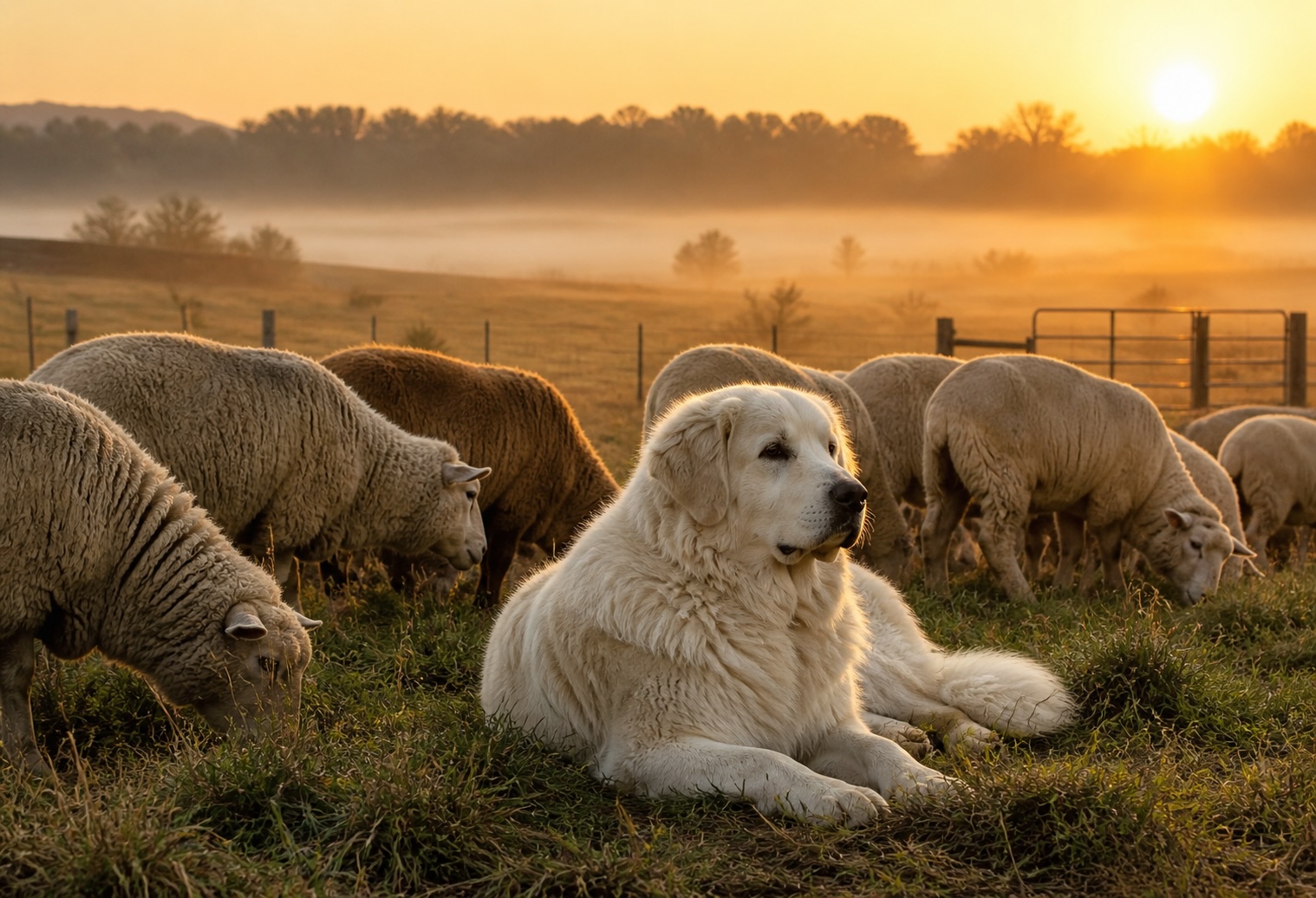
Out in the country, where the air turns still right before dark and every creature seems to know the night shift is coming on, a guardian lying among the flock is a familiar and reassuring sight. That dog is where it belongs. Not nearby. Not on standby. Right there in the middle of the animals it has claimed as its own. That is why livestock guardians live with the flock, and that is why the arrangement has endured for centuries.
For dog owners interested in herding dogs, this can be surprising at first. Herding breeds usually work in partnership with a handler, taking direction and controlling stock through pressure and movement. Livestock guardian dogs are built for a different job. Breeds like the Great Pyrenees, Anatolian Shepherd, Maremma Sheepdog, Akbash, and Komondor were developed to stay with vulnerable animals and make independent decisions day and night. They are not there to gather sheep into a gate on command. They are there to convince predators that the flock is defended every hour they are thinking about making a move.
The Bond Comes Before the Protection
The central reason livestock guardians live with the flock is simple: they protect what they believe belongs to them. That belief is not abstract. It is formed through daily contact, scent, routine, and trust. A guardian pup raised correctly around sheep or goats begins to identify those animals as its social group. It learns their sounds, their movement, their moods, and their normal patterns. Once that bond is established, the dog does not need to be told every evening to watch over them. It already feels that duty.
I have seen this difference plain as day. A dog kept apart from stock may bark at danger, may patrol a fence, and may even show some interest in guarding. But a dog that has bedded down beside lambing ewes or paced the edges of a goat pasture through cold rain carries itself differently. It notices when one animal lags behind. It reacts when the flock startles. It reads the night sounds around them as if every rustle matters, because to that dog, it does.
That deep attachment is what gives livestock guardian dogs their steadiness. They are not merely defending property lines. They are defending living animals they know.
Why Early Exposure Matters
Pups do not come out of the whelping box fully trained, but they do come with instincts that need the right outlet. Early and careful exposure to livestock helps point those instincts in the proper direction. A young guardian that spends its formative months near calm, confident stock begins to accept them as normal companions rather than exciting objects to chase or play with. That process takes supervision, patience, and correction, but it cannot be replaced by occasional visits from a kennel.
Living with the flock teaches lessons a handler cannot replicate from a distance. The pup learns that lambs are delicate, that ewes set boundaries, that goats can be stubborn, and that quiet presence matters more than constant motion. Over time, roughness gives way to calm watchfulness in well-bred, well-managed dogs.
Predators Do Not Keep Office Hours
Another reason livestock guardian dogs live with the flock is that predators do not attack on a schedule that suits people. Coyotes slip along edges at dusk. Stray dogs prowl after midnight. Foxes test weak spots at dawn. In some country, bears, mountain lions, wolves, or feral hogs add another layer of pressure. A guardian that is locked away from the stock when darkness falls is absent when it is needed most.
Guardians work by constant presence as much as by direct confrontation. Their scent around the flock, their barking at suspicious movement, and their patrol routes create a living warning sign. Many predators never commit to an attack once they realize a serious dog is among the animals. That matters more than people realize. The best guardian often wins by preventing a fight before it starts.
When the dog lives with the flock, there is no lag time. No one has to hear a commotion, pull on boots, and turn a dog loose in the dark. The guardian is already there, already reading the situation, already placing itself between threat and stock. In rough country, those few minutes can mean the difference between a close call and a dead lamb.
Protection Is More Than Fighting
Folks who are new to livestock guardians sometimes picture a dramatic showdown every time danger appears. In truth, much of the job is quieter. A guardian dog watches. It patrols. It positions itself on a rise where it can see movement. It barks to announce that the flock is not undefended. It escorts animals into safer areas. It may even simply stand its ground with such confidence that a predator decides the meal is not worth the damage.
Living with the flock allows that whole chain of behavior to happen naturally. The dog does not arrive late and confused. It responds from within the group it is protecting.
Living Together Builds Calm Stock
There is another practical piece to this arrangement that experienced stockmen appreciate. Livestock often settle better when they are accustomed to their guardian dogs. Sheep and goats that know the dog as part of daily life are less likely to spook at its movement and more likely to bunch around it when alarmed. That response can be valuable when pressure comes hard and fast.
I have watched bands of sheep in open country drift toward their guardian after hearing coyotes off the ridge. They did not scatter from the dog. They drew confidence from it. That does not happen overnight. It comes from long familiarity. The dog is not an outside force entering the flock. It is part of the flock's world.
That relationship also reduces stress in routine handling. A guardian living among stock learns their rhythms and tends to move in ways that fit those rhythms. A dog that is constantly removed from the livestock and reintroduced can create unnecessary agitation, especially if it has not settled into a dependable role.
Guardian Dogs Are Meant to Think for Themselves
One of the biggest differences between livestock guardian dogs and many other working dogs is independence. Guardians were bred to make decisions without waiting for human instruction. Out on remote range or in big night pastures, there is no handler beside them whispering commands. They must judge distance, threat level, weather, terrain, and animal behavior on their own.
That independence only works properly when the dog is immersed in the life of the flock. Living with the animals gives it constant information. It knows what normal looks like, sounds like, and smells like. Then, when something changes, it recognizes the difference quickly. A dog kenneled apart simply does not gather that same level of detail.
This is where many beginners make a costly mistake. They treat a guardian like a pet that visits livestock for work shifts. Then they wonder why the dog lacks seriousness, wanders, or focuses more on people than stock. The answer is usually right in front of them. Guardians are shaped by where they live and what they live with.
Why Human Bonding Must Be Balanced
A sound livestock guardian should be manageable by people, but it should not be so human-focused that it abandons stock to seek company at the house. Too much household life can pull the dog's center away from the flock. That is why experienced producers handle guardian pups enough to teach manners and trust, while still keeping the livestock as the dog's primary social attachment.
That balance matters for dog owners coming from herding or sporting backgrounds. With many dogs, strong handler focus is a major advantage. With guardians, overdoing it can work against the job.
The Flock Is the Dog's Territory and Purpose
When a guardian lives with livestock, the pasture, bedding grounds, trails, gates, and edges of cover become meaningful territory. The dog learns where vulnerable animals rest, where predators are likely to test boundaries, and which corners need extra attention after dark. That kind of knowledge cannot be rushed. It is earned by repetition, weather, and long nights.
Purpose matters too. Good guardian dogs are not happy when they are idle and disconnected from work. The flock gives them a clear role. It channels their size, their voice, their watchfulness, and their suspicion of intruders into something useful. A guardian without stock can become bored, nuisance barky, or prone to roaming. A guardian with stock has a reason to stay engaged.
That is one reason these dogs should never be chosen on looks alone. Their beauty is real, no doubt about it, but underneath the coat is a working mind that needs the right life.
What Dog Owners Should Take From This
For readers of Herding Dog Central, the main takeaway is that livestock guardian dogs are not failed herding dogs and they are not oversized pets with extra courage. They are specialists. They live with the flock because their protection depends on bond, presence, familiarity, and independence. Remove those pieces, and you weaken the very traits that make them effective.
If you are considering one for sheep or goats, think first about management and setup. Ask yourself whether the dog can truly live with the stock, whether fencing supports the job, and whether you are ready to raise a young guardian with patient supervision instead of expecting instant perfection. These dogs can be extraordinary, but they need a life that matches their design.
Out in the country, where the air turns still right before dark and every creature seems to know the night shift is coming on, a guardian lying among the flock is a familiar and reassuring sight. That dog is where it belongs. Not nearby. Not on standby. Right there in the middle of the animals it has claimed as its own. That is why livestock guardians live with the flock, and that is why the arrangement has endured for centuries.