Malamutes as Freight Dogs
Power, Endurance, and the Working Legacy of the North
Jeff Davis | https://herdingdogcentral.com
 0
0 0
0 0
0 0
0 0
0
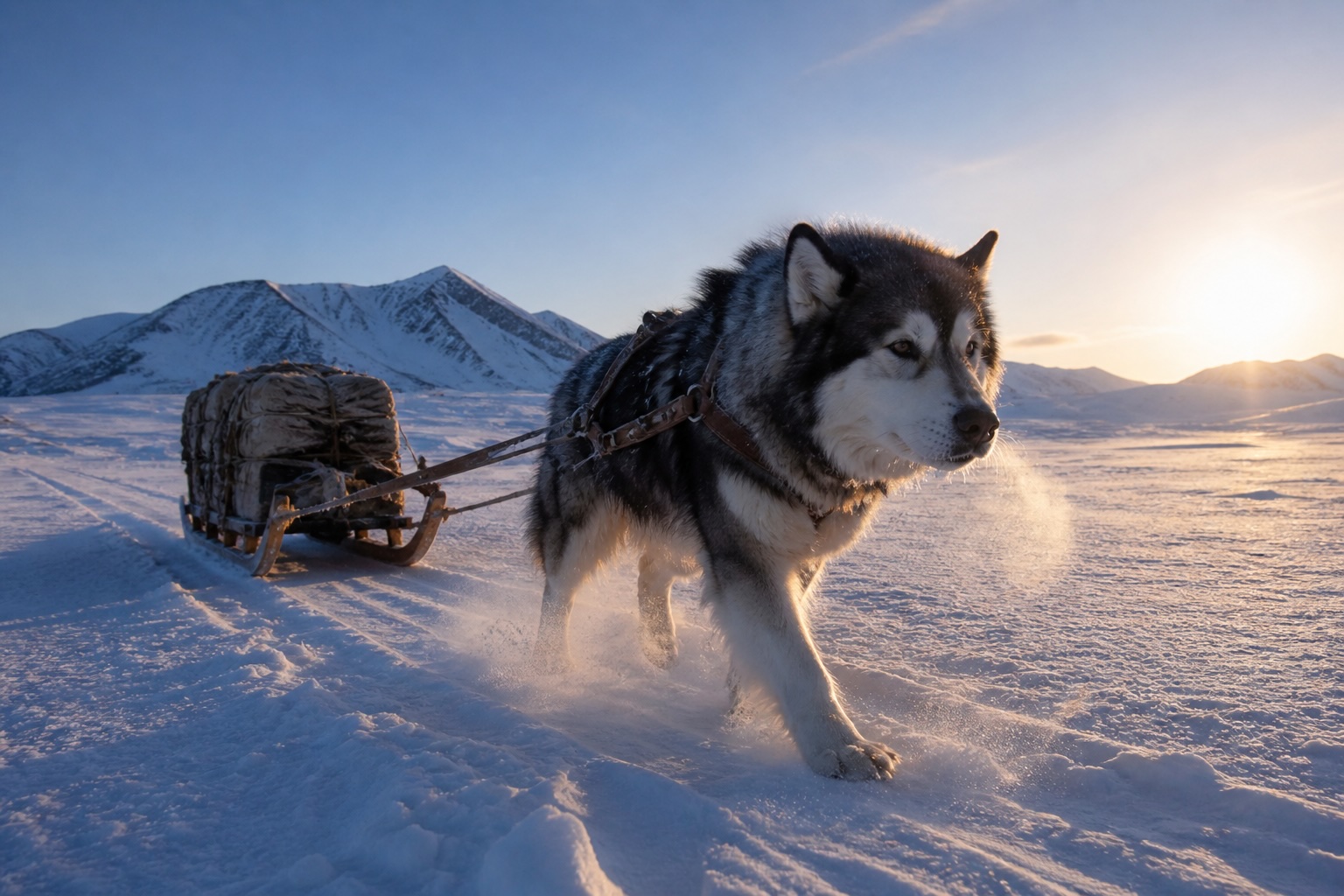
Spend enough time around true working dogs and you start to see the difference between a breed that was made for speed and one that was made for burden. The Alaskan Malamute falls squarely into that second camp. This is not a flashy sprinter built to skim over snow with a light rig behind him. The Malamute was bred to lean into a load, lower his chest, dig in with powerful hindquarters, and keep moving when the trail got mean and the weather turned hard. That old freight dog history is written all through the breed, from the broad head to the deep chest to the steady, practical mind.
Folks who come from herding dog circles often recognize working instinct quickly, even in a breed with a different job description. A good stock dog gathers, balances pressure, and responds to movement with precision. A good freight dog does something else just as demanding. He accepts weight, resists quitting, and works with a kind of durable patience. In a Malamute, that patience is one of the breed's defining strengths. He was never designed to be frantic. He was designed to be reliable.
The Freight Dog Origins of the Alaskan Malamute
The Alaskan Malamute developed in the far North, where survival had little room for useless traits. The breed is closely tied to the Mahlemut people of Alaska, who relied on strong dogs to haul supplies over snow and ice in country that could punish weakness fast. These dogs were not ornaments and they were not casual companions in the modern sense. They were part of daily life, part of travel, and part of the hard arithmetic of getting meat, fuel, and equipment from one place to another.
That freight work mattered. In Arctic travel, there is a world of difference between moving a light load quickly and moving a heavy load dependably. Freight dogs had to carry the burden of camp, trade goods, and provisions. They needed bone, muscle, foot toughness, thick coats, and a mind that could stay composed under strain. The Malamute earned his place by doing exactly that.
Old northern dog men understood something many first-time owners miss today. A freight dog is not only strong. He is efficient. Every inch of him should serve the work. The Malamute's broad frame and substantial substance were not bred for show-ring drama. They were there because a dog pulling serious weight across rough ground must be put together to absorb pressure without breaking down.
Built for Pulling, Not Racing
If you picture all sled dogs as interchangeable, the Malamute will teach you otherwise. Compared with faster sledding breeds, the Malamute is heavier, more deliberate, and more powerful through the body. He is the dog you would trust with a loaded freight sled when distance and terrain demanded grit more than raw speed. That slower, stronger style is at the heart of the breed's identity.
I have always admired that kind of dog. In the field, whether you are talking bird dogs, stock dogs, or northern breeds, there is something reassuring about an animal that knows how to settle into work and stay there. The Malamute does not waste himself. He leans into the harness with a measured seriousness that makes sense once you understand the job he was bred for.
The Traits That Made Malamutes Valuable Freight Dogs
Strength comes first, but it is not the whole story. Plenty of dogs are strong for a short while. A true freight dog needs endurance that holds up over hours and miles. The Malamute's body reflects that need. He carries heavy bone, strong shoulders, a deep chest for lung capacity, and a hind end built to drive. His feet, often overlooked by casual admirers, are part of the equation too. In hard country, weak feet can end a journey faster than a thin coat.
Then there is the coat. Northern weather does not forgive poor insulation. The Malamute's dense double coat helped shield him from bitter wind and ground cold, allowing him to conserve energy while traveling and resting outdoors. It is one thing to admire a thick coat in a photograph. It is another to understand that, for a freight dog, that coat was working equipment as essential as harness leather.
Temperament matters just as much as structure. A Malamute should be confident, independent, and capable of sustained effort without falling apart mentally. Freight work demanded a dog that could tolerate discomfort, uncertainty, and repetition. He had to pull when the load felt wrong, when the trail dragged, and when the sky promised more trouble. That kind of steadiness is not accidental. It is the product of generations bred to function in severe conditions.
A Working Mind With Independent Judgment
This is where modern owners sometimes get crossed up. The Malamute is intelligent, but he is not wired to obey with the reflexive eagerness people often associate with herding breeds. He has an old working mind, one shaped by tasks that required persistence more than constant direction. That independence served him well as a freight dog. He could not be soft, panicky, or helpless. He needed to think through pressure and keep going.
For experienced dog people, that trait is not a flaw. It is a working characteristic. But it does mean training a Malamute calls for patience, fairness, and consistency. Heavy-handed handling usually gets you nowhere worth going. Respect the breed's nature and you can build a dependable partner. Fight it, and you often end up in a contest of wills you did not need.
How Freight Work Still Shapes the Modern Malamute
Even in homes far removed from snow country, the freight dog heritage stays with the breed. You can see it in the way many Malamutes enjoy pulling, carrying, or engaging their bodies against resistance. Harness sports, backpacking, and structured weight-pull activities can give a sound, well-conditioned Malamute a lawful outlet for instincts that were once tied to survival. The key is understanding that this is not a decorative trait. It is a deep working inheritance.
That history also explains why many Malamutes struggle when kept idle. A dog bred to haul freight does not always thrive as a backyard ornament. Without enough physical challenge and mental engagement, boredom can turn into nuisance behavior, escape attempts, digging, or plain stubborn household trouble. Owners who appreciate the breed's roots usually manage this better because they stop asking the dog to be something he was never meant to be.
I have seen the same principle in many working breeds. When you honor the original job, the dog often makes more sense. The Malamute was built to work with purpose. Give him no purpose at all, and you should not be surprised when he invents one.
Can a Malamute Still Do Freight Work Today?
In the right hands, yes, though modern freight work usually looks different from the historical role. Recreational sledding, carting, skijoring support, packing, and conditioning pulls can all tap into the breed's natural talents. Not every Malamute is suited to every task, and health, structure, age, weather, and training all matter. Still, the breed remains one of the clearest examples of a dog designed for pulling weight with determination.
Owners should be realistic. You do not take a house-kept dog with no conditioning, throw a harness on him, and ask for freight work. Muscles, joints, pads, and cardiovascular fitness all need careful preparation. Good equipment matters. So does surface, temperature, and load management. A freight dog may be tough, but wise handling has always been part of successful dog work.
What Herding Dog Owners Should Understand About Malamutes
For readers who know herding breeds best, the Malamute offers an interesting contrast. Both types are working dogs, but they solve different problems. Herding dogs often bring responsiveness, quick directional change, and a sharp eye for pressure. Malamutes bring draft power, resilience, and a grounded kind of confidence. They are not lesser workers. They are different specialists.
That difference shows up in daily life. A Malamute may not look to you for constant instruction the way many herding dogs do. He may assess first, then comply. He may be affectionate, loyal, and deeply bonded, yet still carry a streak of self-possession that surprises owners used to more handler-focused breeds. Understanding this prevents unfair expectations and leads to better management.
It also helps to remember that prey drive, same-sex dog issues, and roaming tendencies can be real considerations in the breed. A freight dog from harsh country needed initiative and toughness, and those traits do not always fit neatly into suburban living. That does not make the Malamute unsuitable. It means the owner needs honesty, secure containment, and a willingness to work with the dog in front of them rather than the dog they imagined.
The Enduring Appeal of the Malamute Freight Dog
There is something admirable about a breed that was made for hard usefulness and still carries that old identity with dignity. The Alaskan Malamute was not created to dazzle for a moment. He was created to endure, to pull, and to serve in conditions that tested every living thing on the trail. That freight dog background is not a romantic side note. It is the foundation of the breed.
When you watch a good Malamute settle into harness, there is a sense that the dog understands his purpose all the way down to the marrow. The chest drops, the line tightens, and the movement becomes steady and economical. No wasted motion. No foolish drama. Just power applied with patience. In my experience, that kind of honest work tells you more about a breed than any polished description ever could.
For modern owners, the lesson is simple. If you want to live well with a Malamute, respect the freight dog beneath the coat and companionship. Give him structure, challenge, fair handling, and room to use his body and mind. Do that, and you are far more likely to see the qualities that made this northern powerhouse one of history's great hauling dogs.
Folks who come from herding dog circles often recognize working instinct quickly, even in a breed with a different job description. A good stock dog gathers, balances pressure, and responds to movement with precision. A good freight dog does something else just as demanding. He accepts weight, resists quitting, and works with a kind of durable patience. In a Malamute, that patience is one of the breed's defining strengths. He was never designed to be frantic. He was designed to be reliable.
The Freight Dog Origins of the Alaskan Malamute
The Alaskan Malamute developed in the far North, where survival had little room for useless traits. The breed is closely tied to the Mahlemut people of Alaska, who relied on strong dogs to haul supplies over snow and ice in country that could punish weakness fast. These dogs were not ornaments and they were not casual companions in the modern sense. They were part of daily life, part of travel, and part of the hard arithmetic of getting meat, fuel, and equipment from one place to another.
That freight work mattered. In Arctic travel, there is a world of difference between moving a light load quickly and moving a heavy load dependably. Freight dogs had to carry the burden of camp, trade goods, and provisions. They needed bone, muscle, foot toughness, thick coats, and a mind that could stay composed under strain. The Malamute earned his place by doing exactly that.
Old northern dog men understood something many first-time owners miss today. A freight dog is not only strong. He is efficient. Every inch of him should serve the work. The Malamute's broad frame and substantial substance were not bred for show-ring drama. They were there because a dog pulling serious weight across rough ground must be put together to absorb pressure without breaking down.
Built for Pulling, Not Racing
If you picture all sled dogs as interchangeable, the Malamute will teach you otherwise. Compared with faster sledding breeds, the Malamute is heavier, more deliberate, and more powerful through the body. He is the dog you would trust with a loaded freight sled when distance and terrain demanded grit more than raw speed. That slower, stronger style is at the heart of the breed's identity.
I have always admired that kind of dog. In the field, whether you are talking bird dogs, stock dogs, or northern breeds, there is something reassuring about an animal that knows how to settle into work and stay there. The Malamute does not waste himself. He leans into the harness with a measured seriousness that makes sense once you understand the job he was bred for.
The Traits That Made Malamutes Valuable Freight Dogs
Strength comes first, but it is not the whole story. Plenty of dogs are strong for a short while. A true freight dog needs endurance that holds up over hours and miles. The Malamute's body reflects that need. He carries heavy bone, strong shoulders, a deep chest for lung capacity, and a hind end built to drive. His feet, often overlooked by casual admirers, are part of the equation too. In hard country, weak feet can end a journey faster than a thin coat.
Then there is the coat. Northern weather does not forgive poor insulation. The Malamute's dense double coat helped shield him from bitter wind and ground cold, allowing him to conserve energy while traveling and resting outdoors. It is one thing to admire a thick coat in a photograph. It is another to understand that, for a freight dog, that coat was working equipment as essential as harness leather.
Temperament matters just as much as structure. A Malamute should be confident, independent, and capable of sustained effort without falling apart mentally. Freight work demanded a dog that could tolerate discomfort, uncertainty, and repetition. He had to pull when the load felt wrong, when the trail dragged, and when the sky promised more trouble. That kind of steadiness is not accidental. It is the product of generations bred to function in severe conditions.
A Working Mind With Independent Judgment
This is where modern owners sometimes get crossed up. The Malamute is intelligent, but he is not wired to obey with the reflexive eagerness people often associate with herding breeds. He has an old working mind, one shaped by tasks that required persistence more than constant direction. That independence served him well as a freight dog. He could not be soft, panicky, or helpless. He needed to think through pressure and keep going.
For experienced dog people, that trait is not a flaw. It is a working characteristic. But it does mean training a Malamute calls for patience, fairness, and consistency. Heavy-handed handling usually gets you nowhere worth going. Respect the breed's nature and you can build a dependable partner. Fight it, and you often end up in a contest of wills you did not need.
How Freight Work Still Shapes the Modern Malamute
Even in homes far removed from snow country, the freight dog heritage stays with the breed. You can see it in the way many Malamutes enjoy pulling, carrying, or engaging their bodies against resistance. Harness sports, backpacking, and structured weight-pull activities can give a sound, well-conditioned Malamute a lawful outlet for instincts that were once tied to survival. The key is understanding that this is not a decorative trait. It is a deep working inheritance.
That history also explains why many Malamutes struggle when kept idle. A dog bred to haul freight does not always thrive as a backyard ornament. Without enough physical challenge and mental engagement, boredom can turn into nuisance behavior, escape attempts, digging, or plain stubborn household trouble. Owners who appreciate the breed's roots usually manage this better because they stop asking the dog to be something he was never meant to be.
I have seen the same principle in many working breeds. When you honor the original job, the dog often makes more sense. The Malamute was built to work with purpose. Give him no purpose at all, and you should not be surprised when he invents one.
Can a Malamute Still Do Freight Work Today?
In the right hands, yes, though modern freight work usually looks different from the historical role. Recreational sledding, carting, skijoring support, packing, and conditioning pulls can all tap into the breed's natural talents. Not every Malamute is suited to every task, and health, structure, age, weather, and training all matter. Still, the breed remains one of the clearest examples of a dog designed for pulling weight with determination.
Owners should be realistic. You do not take a house-kept dog with no conditioning, throw a harness on him, and ask for freight work. Muscles, joints, pads, and cardiovascular fitness all need careful preparation. Good equipment matters. So does surface, temperature, and load management. A freight dog may be tough, but wise handling has always been part of successful dog work.
What Herding Dog Owners Should Understand About Malamutes
For readers who know herding breeds best, the Malamute offers an interesting contrast. Both types are working dogs, but they solve different problems. Herding dogs often bring responsiveness, quick directional change, and a sharp eye for pressure. Malamutes bring draft power, resilience, and a grounded kind of confidence. They are not lesser workers. They are different specialists.
That difference shows up in daily life. A Malamute may not look to you for constant instruction the way many herding dogs do. He may assess first, then comply. He may be affectionate, loyal, and deeply bonded, yet still carry a streak of self-possession that surprises owners used to more handler-focused breeds. Understanding this prevents unfair expectations and leads to better management.
It also helps to remember that prey drive, same-sex dog issues, and roaming tendencies can be real considerations in the breed. A freight dog from harsh country needed initiative and toughness, and those traits do not always fit neatly into suburban living. That does not make the Malamute unsuitable. It means the owner needs honesty, secure containment, and a willingness to work with the dog in front of them rather than the dog they imagined.
The Enduring Appeal of the Malamute Freight Dog
There is something admirable about a breed that was made for hard usefulness and still carries that old identity with dignity. The Alaskan Malamute was not created to dazzle for a moment. He was created to endure, to pull, and to serve in conditions that tested every living thing on the trail. That freight dog background is not a romantic side note. It is the foundation of the breed.
When you watch a good Malamute settle into harness, there is a sense that the dog understands his purpose all the way down to the marrow. The chest drops, the line tightens, and the movement becomes steady and economical. No wasted motion. No foolish drama. Just power applied with patience. In my experience, that kind of honest work tells you more about a breed than any polished description ever could.
For modern owners, the lesson is simple. If you want to live well with a Malamute, respect the freight dog beneath the coat and companionship. Give him structure, challenge, fair handling, and room to use his body and mind. Do that, and you are far more likely to see the qualities that made this northern powerhouse one of history's great hauling dogs.