Black Russian Terriers as Draft Dogs
Strength, Sense, and Steady Work
Jeff Davis | https://herdingdogcentral.com
 0
0 0
0 0
0 0
0 0
0
I have spent enough years around serious working dogs to know that strength alone never makes a true draft dog. A dog may have bone, mass, and a chest like a barrel, but if the head is wrong or the nerves are shaky, the cart will teach that truth in a hurry. The Black Russian Terrier is one of those breeds that catches a working dog person’s eye fast. Big, imposing, and built with purpose, this breed carries the kind of presence that makes folks assume it can pull whatever you hitch behind it. In many cases, that instinct is not far off. Black Russian Terriers can make capable draft dogs, but the answer is not as simple as size and muscle.
For dog owners interested in herding and other traditional working roles, the Black Russian Terrier offers something a little different. This is not a classic pasture dog bred to gather sheep all day, but it is a utility worker with the kind of power, intelligence, and steadiness that can translate well to carting and draft tasks. With proper structure, slow conditioning, and careful training, a Black Russian Terrier can become a dependable partner in harness.
The Working Roots Behind the Breed
The Black Russian Terrier was developed in the Soviet Union as a serious utility dog, not as a decorative giant. The breed was created by blending several working lines, including the Giant Schnauzer, Rottweiler, Airedale Terrier, and others, with the goal of producing a hardy, trainable dog suited for demanding service. That foundation matters when we talk about draft work. This breed was never meant to be delicate, and it was certainly not intended to stand idle.
When you look at a good Black Russian Terrier, you see substance everywhere. The neck is strong, the body is solid, the hindquarters provide drive, and the feet should support real labor. Those traits do not automatically make every individual dog a natural cart puller, but they do create a breed that has the raw physical equipment for draft tasks. Just as important, many Black Russian Terriers have the mental seriousness to settle into a job and take direction without constant fuss.
Why Draft Work Fits Their Nature
Some dogs pull because they are frantic and forward; others pull because they understand the assignment. I prefer the second sort. Black Russian Terriers tend to approach work with a thoughtful, controlled attitude. They are not usually as flashy or hyperkinetic as lighter sporting breeds, and for draft work that can be a blessing. A good draft dog needs to move with purpose, tolerate equipment, handle changing terrain, and remain calm when the cart rattles, bumps, or shifts behind them.
This breed often has a natural suspicion of nonsense and a solid sense of self. That means they may not throw themselves into a new task on day one just to please you. You usually have to earn their confidence and show them the job in a way that makes sense. Once that understanding is there, many Black Russian Terriers become remarkably reliable workers.
What Makes a Black Russian Terrier Suitable for Carting
The first thing to understand is that not every Black Russian Terrier should do draft work. Temperament, structure, age, and health all matter. A sound dog with good hips, stable elbows, strong pasterns, proper feet, and a level mind has a fair shot at success. A dog that is cow-hocked, soft in the topline, mentally sharp in the wrong ways, or carrying too much weight may struggle or even risk injury.
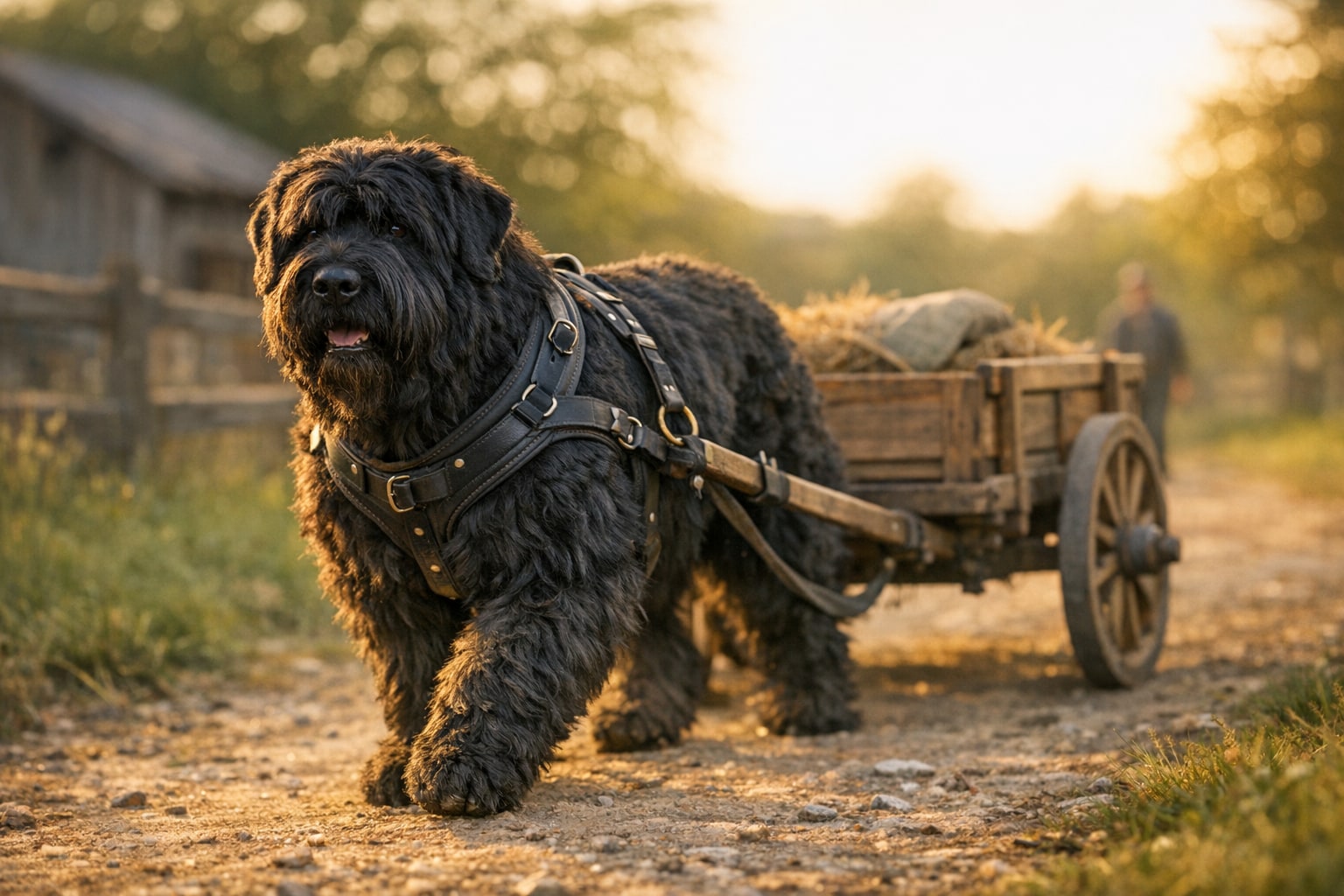
One reason Black Russian Terriers can do well in harness is their balance of mass and coordination. They are large dogs, but a well-built individual should still move efficiently. Draft work is not simply about dragging weight. It is about engaging the whole body in a controlled, sustainable way. A dog that can lean into a breastcollar or weight-pull style harness, push from the rear, and maintain a steady line of travel has the mechanics needed for practical carting.
Their coat can also be an advantage and a complication. In cool weather, that dense black coat offers protection and makes the breed well suited to outdoor work. In warm climates, however, heat management becomes a serious concern. A draft dog cannot perform safely if it is overheating under a heavy coat. Owners need to think like working dog handlers, not casual walkers. Weather, ground conditions, hydration, and workload all need to be judged honestly.
Temperament Counts More Than Pride
I have seen more than one owner assume that a large, brave-looking dog would naturally take to pulling. Sometimes the dog had other ideas. Black Russian Terriers are intelligent and often deeply bonded to their people, but they are not machines. Some are naturally confident with novel objects and noisy gear. Others need patient desensitization before they trust shafts, traces, and the feel of pressure behind them.
The best draft prospects in this breed tend to be calm, resilient, and willing to work through mild uncertainty without shutting down. They should be biddable without being soft. A dog that panics when a cart wheel hits a rut is dangerous to itself and everyone nearby. A dog that pauses, thinks, and waits for a cue is worth its weight in feed.
Training a Black Russian Terrier for Draft Work
Draft training should begin long before any load is attached. The first lessons are about manners, body awareness, and trust. A Black Russian Terrier should already understand leash pressure, stop, stand, back, turn, and move out on command. The dog should be comfortable having harness straps adjusted, equipment handled around its legs, and strange objects touching its sides.
When I start a dog on draft foundations, I like to keep the early sessions quiet and almost boring. Let the dog wear the harness. Let it walk, stop, and turn. Let it drag a light object that makes a little noise but does not create panic. You are not building brute force in those first days. You are building acceptance and composure. For a Black Russian Terrier, that measured approach often pays off because the breed tends to think before it commits.
Once the dog is relaxed in equipment, you can begin introducing a light cart or training rig. The load should be minimal at first. Focus on straight lines, smooth starts, steady stops, and calm turns. Teach the dog that the harness pressure means lean and move, not startle and fight. Praise matters, but timing matters more. This breed usually responds best to clear, fair direction rather than endless chatter.
Conditioning and Physical Readiness
A draft dog is an athlete, and Black Russian Terriers need conditioning just like any other working breed. Too many owners think a big dog is automatically in shape. Most are not. Roadwork at a controlled pace, hill walking, free movement on safe ground, and regular strength-building exercise all help prepare a dog for carting. Draft sessions themselves should stay short and progressive.
Joint health deserves special attention. Because Black Russian Terriers are a large breed, owners should avoid serious pulling work until the dog is physically mature and cleared by a veterinarian familiar with working dogs. Even then, loads should be increased gradually. A strong dog can still be damaged by foolish handling. I would much rather see a dog do modest work for years than be overfaced early and break down before its time.
Real-World Uses for a Black Russian Terrier as a Draft Dog
Most modern owners are not hitching dogs to haul firewood off a remote line camp, but draft work still has practical and rewarding uses. A Black Russian Terrier can pull a light utility cart for recreation, demonstrations, farm chores, or organized carting events. Some dogs thrive when given that kind of defined physical job. It channels their energy, sharpens communication, and gives them a purpose beyond the backyard.
I have always believed that many working breeds become easier to live with when they are allowed to do something tangible. A Black Russian Terrier that learns to pull calmly and confidently often gains maturity through the process. The dog learns patience at the start, discipline in motion, and steadiness under pressure. Those lessons carry over into everyday life.
That said, owners need to be honest about scale. This is not a breed that should be treated like a novelty engine for oversized loads or social media stunts. Draft work should be humane, sensible, and rooted in the dog’s welfare. A well-trained Black Russian Terrier can pull usefully, but responsible carting is about teamwork, not ego.
Challenges Owners Should Expect
No breed comes without tradeoffs. Black Russian Terriers can be independent, and some will test whether a command is truly a command or just a suggestion. In draft work, inconsistency from the handler will show up fast. If your cues are muddy, your expectations change by the day, or your sessions end in frustration, the dog will not progress the way it should.
Grooming is another consideration. A neglected coat on a working Black Russian Terrier can mat under harness points and create discomfort. Feet need attention, nails must stay trimmed, and the beard and furnishings should not interfere with safe equipment use. Working dogs require practical care, not just admiration.
Space and handling strength matter too. These are substantial dogs. If one decides to swing wide, brace hard, or object to something in harness, the handler needs both training and control. For beginners, working with an experienced carting instructor is a smart move. A seasoned eye can spot poor fit, stress signals, or movement issues before they become real problems.
Are Black Russian Terriers Good Draft Dogs?
In the right hands, yes, they can be very good draft dogs. They have the size, structure, and mental depth for the work, and many seem to enjoy having a job that calls for both power and composure. They are not the easiest choice for every owner, and they are not a plug-and-play carting breed. But for people who appreciate a serious utility dog and are willing to train with patience, a Black Russian Terrier can become an impressive partner in harness.
What I like most about them in draft work is the same thing I value in any honest working dog. When the training is right and the dog understands its role, there is a moment when the line tightens, the dog leans in, and everything settles into rhythm. No drama, no waste, just steady effort and quiet confidence. That is real work, and the Black Russian Terrier is fully capable of it.
For dog owners interested in herding and other traditional working roles, the Black Russian Terrier offers something a little different. This is not a classic pasture dog bred to gather sheep all day, but it is a utility worker with the kind of power, intelligence, and steadiness that can translate well to carting and draft tasks. With proper structure, slow conditioning, and careful training, a Black Russian Terrier can become a dependable partner in harness.
The Working Roots Behind the Breed
The Black Russian Terrier was developed in the Soviet Union as a serious utility dog, not as a decorative giant. The breed was created by blending several working lines, including the Giant Schnauzer, Rottweiler, Airedale Terrier, and others, with the goal of producing a hardy, trainable dog suited for demanding service. That foundation matters when we talk about draft work. This breed was never meant to be delicate, and it was certainly not intended to stand idle.
When you look at a good Black Russian Terrier, you see substance everywhere. The neck is strong, the body is solid, the hindquarters provide drive, and the feet should support real labor. Those traits do not automatically make every individual dog a natural cart puller, but they do create a breed that has the raw physical equipment for draft tasks. Just as important, many Black Russian Terriers have the mental seriousness to settle into a job and take direction without constant fuss.
Why Draft Work Fits Their Nature
Some dogs pull because they are frantic and forward; others pull because they understand the assignment. I prefer the second sort. Black Russian Terriers tend to approach work with a thoughtful, controlled attitude. They are not usually as flashy or hyperkinetic as lighter sporting breeds, and for draft work that can be a blessing. A good draft dog needs to move with purpose, tolerate equipment, handle changing terrain, and remain calm when the cart rattles, bumps, or shifts behind them.
This breed often has a natural suspicion of nonsense and a solid sense of self. That means they may not throw themselves into a new task on day one just to please you. You usually have to earn their confidence and show them the job in a way that makes sense. Once that understanding is there, many Black Russian Terriers become remarkably reliable workers.
What Makes a Black Russian Terrier Suitable for Carting
The first thing to understand is that not every Black Russian Terrier should do draft work. Temperament, structure, age, and health all matter. A sound dog with good hips, stable elbows, strong pasterns, proper feet, and a level mind has a fair shot at success. A dog that is cow-hocked, soft in the topline, mentally sharp in the wrong ways, or carrying too much weight may struggle or even risk injury.
One reason Black Russian Terriers can do well in harness is their balance of mass and coordination. They are large dogs, but a well-built individual should still move efficiently. Draft work is not simply about dragging weight. It is about engaging the whole body in a controlled, sustainable way. A dog that can lean into a breastcollar or weight-pull style harness, push from the rear, and maintain a steady line of travel has the mechanics needed for practical carting.
Their coat can also be an advantage and a complication. In cool weather, that dense black coat offers protection and makes the breed well suited to outdoor work. In warm climates, however, heat management becomes a serious concern. A draft dog cannot perform safely if it is overheating under a heavy coat. Owners need to think like working dog handlers, not casual walkers. Weather, ground conditions, hydration, and workload all need to be judged honestly.
Temperament Counts More Than Pride
I have seen more than one owner assume that a large, brave-looking dog would naturally take to pulling. Sometimes the dog had other ideas. Black Russian Terriers are intelligent and often deeply bonded to their people, but they are not machines. Some are naturally confident with novel objects and noisy gear. Others need patient desensitization before they trust shafts, traces, and the feel of pressure behind them.
The best draft prospects in this breed tend to be calm, resilient, and willing to work through mild uncertainty without shutting down. They should be biddable without being soft. A dog that panics when a cart wheel hits a rut is dangerous to itself and everyone nearby. A dog that pauses, thinks, and waits for a cue is worth its weight in feed.
Training a Black Russian Terrier for Draft Work
Draft training should begin long before any load is attached. The first lessons are about manners, body awareness, and trust. A Black Russian Terrier should already understand leash pressure, stop, stand, back, turn, and move out on command. The dog should be comfortable having harness straps adjusted, equipment handled around its legs, and strange objects touching its sides.
When I start a dog on draft foundations, I like to keep the early sessions quiet and almost boring. Let the dog wear the harness. Let it walk, stop, and turn. Let it drag a light object that makes a little noise but does not create panic. You are not building brute force in those first days. You are building acceptance and composure. For a Black Russian Terrier, that measured approach often pays off because the breed tends to think before it commits.
Once the dog is relaxed in equipment, you can begin introducing a light cart or training rig. The load should be minimal at first. Focus on straight lines, smooth starts, steady stops, and calm turns. Teach the dog that the harness pressure means lean and move, not startle and fight. Praise matters, but timing matters more. This breed usually responds best to clear, fair direction rather than endless chatter.
Conditioning and Physical Readiness
A draft dog is an athlete, and Black Russian Terriers need conditioning just like any other working breed. Too many owners think a big dog is automatically in shape. Most are not. Roadwork at a controlled pace, hill walking, free movement on safe ground, and regular strength-building exercise all help prepare a dog for carting. Draft sessions themselves should stay short and progressive.
Joint health deserves special attention. Because Black Russian Terriers are a large breed, owners should avoid serious pulling work until the dog is physically mature and cleared by a veterinarian familiar with working dogs. Even then, loads should be increased gradually. A strong dog can still be damaged by foolish handling. I would much rather see a dog do modest work for years than be overfaced early and break down before its time.
Real-World Uses for a Black Russian Terrier as a Draft Dog
Most modern owners are not hitching dogs to haul firewood off a remote line camp, but draft work still has practical and rewarding uses. A Black Russian Terrier can pull a light utility cart for recreation, demonstrations, farm chores, or organized carting events. Some dogs thrive when given that kind of defined physical job. It channels their energy, sharpens communication, and gives them a purpose beyond the backyard.
I have always believed that many working breeds become easier to live with when they are allowed to do something tangible. A Black Russian Terrier that learns to pull calmly and confidently often gains maturity through the process. The dog learns patience at the start, discipline in motion, and steadiness under pressure. Those lessons carry over into everyday life.
That said, owners need to be honest about scale. This is not a breed that should be treated like a novelty engine for oversized loads or social media stunts. Draft work should be humane, sensible, and rooted in the dog’s welfare. A well-trained Black Russian Terrier can pull usefully, but responsible carting is about teamwork, not ego.
Challenges Owners Should Expect
No breed comes without tradeoffs. Black Russian Terriers can be independent, and some will test whether a command is truly a command or just a suggestion. In draft work, inconsistency from the handler will show up fast. If your cues are muddy, your expectations change by the day, or your sessions end in frustration, the dog will not progress the way it should.
Grooming is another consideration. A neglected coat on a working Black Russian Terrier can mat under harness points and create discomfort. Feet need attention, nails must stay trimmed, and the beard and furnishings should not interfere with safe equipment use. Working dogs require practical care, not just admiration.
Space and handling strength matter too. These are substantial dogs. If one decides to swing wide, brace hard, or object to something in harness, the handler needs both training and control. For beginners, working with an experienced carting instructor is a smart move. A seasoned eye can spot poor fit, stress signals, or movement issues before they become real problems.
Are Black Russian Terriers Good Draft Dogs?
In the right hands, yes, they can be very good draft dogs. They have the size, structure, and mental depth for the work, and many seem to enjoy having a job that calls for both power and composure. They are not the easiest choice for every owner, and they are not a plug-and-play carting breed. But for people who appreciate a serious utility dog and are willing to train with patience, a Black Russian Terrier can become an impressive partner in harness.
What I like most about them in draft work is the same thing I value in any honest working dog. When the training is right and the dog understands its role, there is a moment when the line tightens, the dog leans in, and everything settles into rhythm. No drama, no waste, just steady effort and quiet confidence. That is real work, and the Black Russian Terrier is fully capable of it.



View all 0 comments