Developing Distance Control in Herding Dogs
Jeff Davis | https://herdingdogcentral.com
 0
0 0
0 0
0 0
0 0
0
There comes a point in every useful herding dog’s training when close work is no longer enough. A dog may be honest on balance, eager to gather, and keen to please, but if it cannot take direction when it is fifty, a hundred, or two hundred yards away, the work starts to come apart. Stock drift. Lines get ragged. The dog begins making decisions that belong to the handler. Developing distance control is what turns a promising young dog into a practical partner.
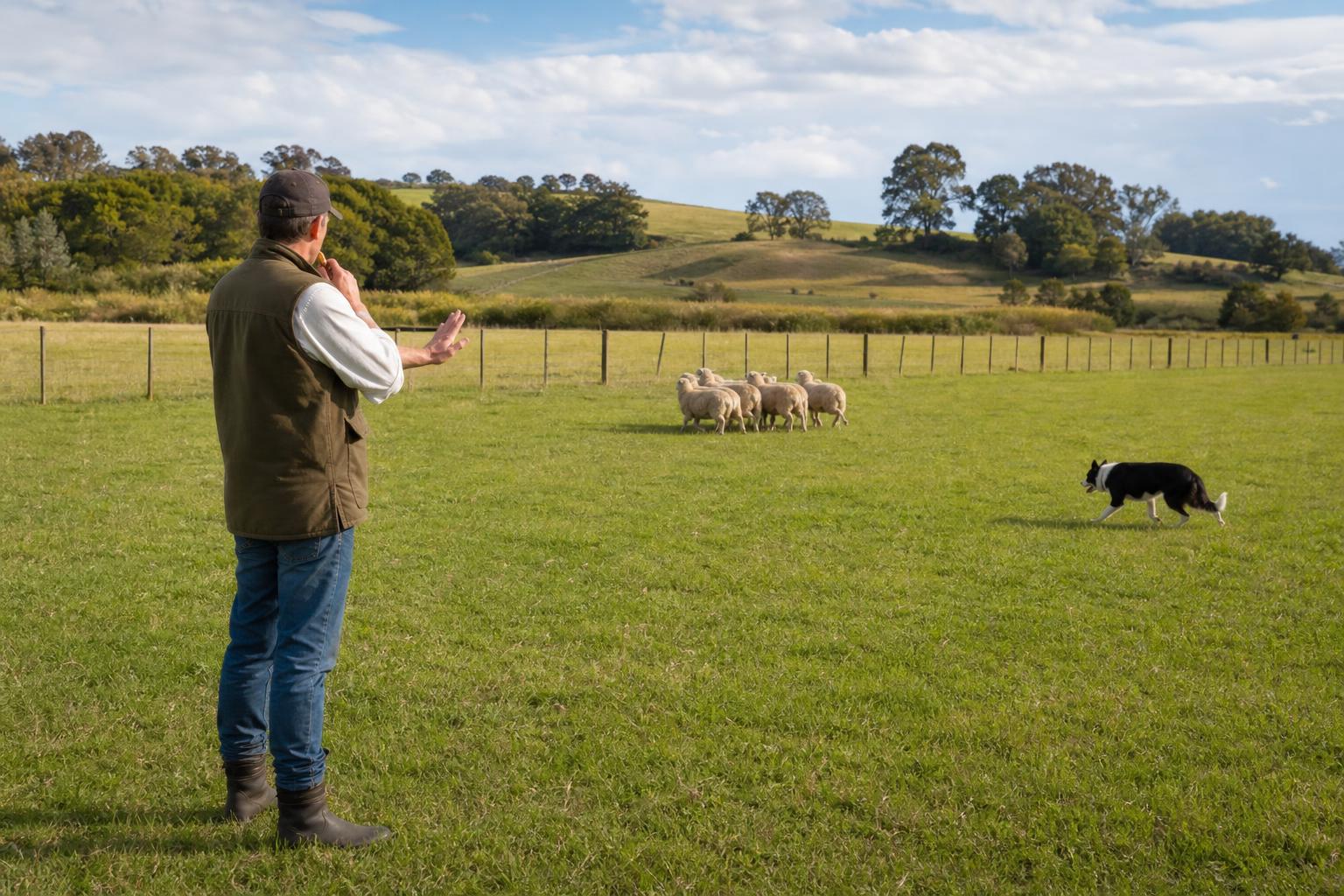
I have always thought of distance control as one of the clearest signs of maturity in a working dog. Any dog can look tidy in a pen with a handler close enough to influence every step. The real test shows up in an open field, a larger pasture, or rough country where wind, terrain, and livestock pressure all interfere with communication. Out there, the dog has to understand more than words. It has to understand responsibility, feel for stock, and the expectation that a command still means the same thing, no matter how far away the handler stands.
Why Distance Control Matters
For dog owners interested in herding dogs, distance control is not just a trial skill or a fancy finishing touch. It is a practical necessity. A dog that can flank, lie down, steady up, and redirect at distance is safer on stock, more useful on large acreage, and far easier to trust in changing situations. Good distance control reduces unnecessary pressure on livestock because the handler can position the dog before things get tight and messy. It also preserves the dog’s confidence, because confusion is replaced by clarity.
I have seen many young dogs get into trouble not because they lacked instinct, but because they were sent too far too soon without enough understanding. The dog slices in on a wide outrun, grips from frustration, or ignores a stop because it has learned that commands fade with distance. Once that habit forms, the handler spends more time repairing holes than building useful work. That is why distance control should be developed steadily, in layers, and always with an eye toward maintaining the dog’s trust.
Start Close Before You Ask Far
The foundation of distance control is never really built at distance. It starts in close, where the handler can shape the response and the dog can succeed without guessing. A clean stop, a correct flank, and a steady walk-up must be reliable at short range before they are expected across a field. That may sound obvious, but many handlers rush this stage because the dog shows natural talent. Talent helps, but talent without control often creates bigger problems because the dog learns it can rely on instinct alone.
When I begin teaching for distance, I want the dog to feel that the command is familiar long before the space between us increases. If “lie down” means stop your feet and hold pressure in a calm, balanced way, then that meaning should not change whether I am ten feet away or eighty yards back. If “come by” means take the flank cleanly and give stock room, then I want the dog hearing the same command in the same tone and finding the same answer every time.
Consistency Builds Reach
Handlers often think louder is better once the dog is farther away. In my experience, that usually creates tension instead of understanding. Distance control depends on consistency more than volume. A steady command, given at the right moment, carries farther in the dog’s mind than shouting ever will. Dogs learn patterns quickly. If the stop command is sometimes enforced and sometimes ignored, the dog notices. If the flank command is used loosely for any sideways movement, the dog notices that too.
The best distance work grows out of plain, repetitive truth. One cue, one meaning, one expected response. Over time, that clarity gives the dog confidence to take instruction when stock are moving, when the field opens up, or when the handler is temporarily out of position.
Timing Is the Handler’s Greatest Tool
In the field, timing matters more than almost anything else. A command given one second too late can force a correction that would never have been needed with earlier handling. Distance makes this even more important because the dog has already committed to motion by the time the handler reacts. If you wait until the dog is crossing too tight to ask for a wider flank, you are no longer teaching. You are trying to patch a mistake after it has begun.
I learned this the hard way behind sheep in a broad pasture, working a dog with plenty of eye and more determination than sense. If I caught him early, just as he thought about cutting in, a quiet flank command was enough. If I waited until he was already bending pressure wrong, the correction became bigger, the sheep got unsettled, and the dog grew irritated. That day reminded me of something every stockman eventually learns: distance magnifies both good timing and bad timing.
To improve distance control, watch the dog’s intention, not just its feet. Most dogs show you what they are about to do before they do it. Their head changes, their pace alters, or their line begins to tighten. Those early signs are where the handler can still shape the work with minimal disruption.
Use Stock to Teach, Not Just Commands
One mistake I see often is handlers trying to teach distance control as if it exists separate from livestock. In truth, stock are the classroom. A herding dog learns distance by discovering how pressure affects movement and by hearing the handler’s directions inside that lesson. If the sheep draw to a gate, the dog begins to understand where its position must be. If cattle challenge pressure, the dog learns that a stop must still hold under stress. The command means something because the work gives it meaning.
That is why the right stock matter. Dog-broke animals that move honestly and do not create unnecessary wrecks are worth their weight in feed when teaching distance. Wild or sticky stock can make a green dog look disobedient when it is really confused or overfaced. Set the stage so the dog can understand its job. Distance control should sharpen the dog’s mind, not scramble it.
Pressure and Release at Range
Every good working dog learns through pressure and release. At distance, that principle becomes even more important because physical help is limited. The release must come from the work itself. When the dog takes a wider flank, the stock settle and the picture improves. When it lies down where asked, pressure comes off and order returns. When it pushes too hard, the livestock break and the job gets harder. The handler’s role is to help the dog connect those dots without overhandling every second.
A dog that truly understands distance control is not merely obeying noise from afar. It is reading stock, listening for direction, and adjusting pressure with purpose. That kind of dog is a pleasure to watch because each command lands on prepared ground.
Build Distance Gradually and Honestly
There is no shortcut here. Distance should be added in small, manageable steps. If the dog is dependable at twenty yards, ask for thirty. If it can hold a stop while stock are drifting slowly, then test that stop with a little more motion. Stretch the dog, but do not gamble with its understanding. Handlers who double the challenge too quickly often end up teaching the dog to ignore commands simply because the task was unfair.
I like to think of it as extending a rope, not cutting it loose. The connection between handler and dog should remain intact as range increases. Sometimes that means returning to a shorter distance for a session or two, especially after confusion. There is no shame in that. Solid work is built by protecting comprehension.
Terrain can also be used wisely. A slight slope, a fenceline, or the natural shape of a field can help the dog hold a line and hear instruction more clearly. Early distance work in impossible conditions is asking for static on the wire. Save the hard wind, heavy draw, and broken ground for when the dog has enough training to absorb them.
Common Faults When Training Distance Control
The most common trouble is inconsistency from the handler. Mixed commands, emotional corrections, and talking too much will blur the dog’s understanding faster than distance ever will. Another frequent issue is stopping the dog only when something has already gone wrong. Before long, the dog begins to associate the stop with frustration or punishment rather than with calm control. A good stop should exist inside normal work, not just during emergencies.
Another problem appears in dogs that are overmanaged. If every stride is directed, the dog never learns to carry responsibility away from the handler. Then once real distance is introduced, the dog either freezes or starts freelancing. The answer is balance. Give enough guidance to shape correct work, but leave room for the dog to think and hold stock honestly.
Trust Is the Final Piece
In the end, developing distance control in herding dogs comes down to trust earned through repetition. The dog must trust that the handler’s commands are timely, fair, and useful. The handler must trust that the dog is trying to work, not merely testing boundaries. When that relationship settles in, distance stops feeling like separation. It becomes an extension of teamwork.
There is a special kind of satisfaction in standing quiet at the edge of a field and watching a trained dog take a clean outrun, lift stock softly, and answer a distant stop as if you were standing at its shoulder. That kind of control is not built in a weekend, and it is never built through force alone. It comes from thoughtful training, good stock sense, and many honest repetitions under real conditions.
For anyone raising or training a herding dog, distance control is worth the time it takes. It gives shape to instinct, steadies excitement, and makes the dog useful where useful matters most. And when the work gets big and the country opens up, you will be grateful for every careful lesson that taught your dog to listen from afar.
I have always thought of distance control as one of the clearest signs of maturity in a working dog. Any dog can look tidy in a pen with a handler close enough to influence every step. The real test shows up in an open field, a larger pasture, or rough country where wind, terrain, and livestock pressure all interfere with communication. Out there, the dog has to understand more than words. It has to understand responsibility, feel for stock, and the expectation that a command still means the same thing, no matter how far away the handler stands.
Why Distance Control Matters
For dog owners interested in herding dogs, distance control is not just a trial skill or a fancy finishing touch. It is a practical necessity. A dog that can flank, lie down, steady up, and redirect at distance is safer on stock, more useful on large acreage, and far easier to trust in changing situations. Good distance control reduces unnecessary pressure on livestock because the handler can position the dog before things get tight and messy. It also preserves the dog’s confidence, because confusion is replaced by clarity.
I have seen many young dogs get into trouble not because they lacked instinct, but because they were sent too far too soon without enough understanding. The dog slices in on a wide outrun, grips from frustration, or ignores a stop because it has learned that commands fade with distance. Once that habit forms, the handler spends more time repairing holes than building useful work. That is why distance control should be developed steadily, in layers, and always with an eye toward maintaining the dog’s trust.
Start Close Before You Ask Far
The foundation of distance control is never really built at distance. It starts in close, where the handler can shape the response and the dog can succeed without guessing. A clean stop, a correct flank, and a steady walk-up must be reliable at short range before they are expected across a field. That may sound obvious, but many handlers rush this stage because the dog shows natural talent. Talent helps, but talent without control often creates bigger problems because the dog learns it can rely on instinct alone.
When I begin teaching for distance, I want the dog to feel that the command is familiar long before the space between us increases. If “lie down” means stop your feet and hold pressure in a calm, balanced way, then that meaning should not change whether I am ten feet away or eighty yards back. If “come by” means take the flank cleanly and give stock room, then I want the dog hearing the same command in the same tone and finding the same answer every time.
Consistency Builds Reach
Handlers often think louder is better once the dog is farther away. In my experience, that usually creates tension instead of understanding. Distance control depends on consistency more than volume. A steady command, given at the right moment, carries farther in the dog’s mind than shouting ever will. Dogs learn patterns quickly. If the stop command is sometimes enforced and sometimes ignored, the dog notices. If the flank command is used loosely for any sideways movement, the dog notices that too.
The best distance work grows out of plain, repetitive truth. One cue, one meaning, one expected response. Over time, that clarity gives the dog confidence to take instruction when stock are moving, when the field opens up, or when the handler is temporarily out of position.
Timing Is the Handler’s Greatest Tool
In the field, timing matters more than almost anything else. A command given one second too late can force a correction that would never have been needed with earlier handling. Distance makes this even more important because the dog has already committed to motion by the time the handler reacts. If you wait until the dog is crossing too tight to ask for a wider flank, you are no longer teaching. You are trying to patch a mistake after it has begun.
I learned this the hard way behind sheep in a broad pasture, working a dog with plenty of eye and more determination than sense. If I caught him early, just as he thought about cutting in, a quiet flank command was enough. If I waited until he was already bending pressure wrong, the correction became bigger, the sheep got unsettled, and the dog grew irritated. That day reminded me of something every stockman eventually learns: distance magnifies both good timing and bad timing.
To improve distance control, watch the dog’s intention, not just its feet. Most dogs show you what they are about to do before they do it. Their head changes, their pace alters, or their line begins to tighten. Those early signs are where the handler can still shape the work with minimal disruption.
Use Stock to Teach, Not Just Commands
One mistake I see often is handlers trying to teach distance control as if it exists separate from livestock. In truth, stock are the classroom. A herding dog learns distance by discovering how pressure affects movement and by hearing the handler’s directions inside that lesson. If the sheep draw to a gate, the dog begins to understand where its position must be. If cattle challenge pressure, the dog learns that a stop must still hold under stress. The command means something because the work gives it meaning.
That is why the right stock matter. Dog-broke animals that move honestly and do not create unnecessary wrecks are worth their weight in feed when teaching distance. Wild or sticky stock can make a green dog look disobedient when it is really confused or overfaced. Set the stage so the dog can understand its job. Distance control should sharpen the dog’s mind, not scramble it.
Pressure and Release at Range
Every good working dog learns through pressure and release. At distance, that principle becomes even more important because physical help is limited. The release must come from the work itself. When the dog takes a wider flank, the stock settle and the picture improves. When it lies down where asked, pressure comes off and order returns. When it pushes too hard, the livestock break and the job gets harder. The handler’s role is to help the dog connect those dots without overhandling every second.
A dog that truly understands distance control is not merely obeying noise from afar. It is reading stock, listening for direction, and adjusting pressure with purpose. That kind of dog is a pleasure to watch because each command lands on prepared ground.
Build Distance Gradually and Honestly
There is no shortcut here. Distance should be added in small, manageable steps. If the dog is dependable at twenty yards, ask for thirty. If it can hold a stop while stock are drifting slowly, then test that stop with a little more motion. Stretch the dog, but do not gamble with its understanding. Handlers who double the challenge too quickly often end up teaching the dog to ignore commands simply because the task was unfair.
I like to think of it as extending a rope, not cutting it loose. The connection between handler and dog should remain intact as range increases. Sometimes that means returning to a shorter distance for a session or two, especially after confusion. There is no shame in that. Solid work is built by protecting comprehension.
Terrain can also be used wisely. A slight slope, a fenceline, or the natural shape of a field can help the dog hold a line and hear instruction more clearly. Early distance work in impossible conditions is asking for static on the wire. Save the hard wind, heavy draw, and broken ground for when the dog has enough training to absorb them.
Common Faults When Training Distance Control
The most common trouble is inconsistency from the handler. Mixed commands, emotional corrections, and talking too much will blur the dog’s understanding faster than distance ever will. Another frequent issue is stopping the dog only when something has already gone wrong. Before long, the dog begins to associate the stop with frustration or punishment rather than with calm control. A good stop should exist inside normal work, not just during emergencies.
Another problem appears in dogs that are overmanaged. If every stride is directed, the dog never learns to carry responsibility away from the handler. Then once real distance is introduced, the dog either freezes or starts freelancing. The answer is balance. Give enough guidance to shape correct work, but leave room for the dog to think and hold stock honestly.
Trust Is the Final Piece
In the end, developing distance control in herding dogs comes down to trust earned through repetition. The dog must trust that the handler’s commands are timely, fair, and useful. The handler must trust that the dog is trying to work, not merely testing boundaries. When that relationship settles in, distance stops feeling like separation. It becomes an extension of teamwork.
There is a special kind of satisfaction in standing quiet at the edge of a field and watching a trained dog take a clean outrun, lift stock softly, and answer a distant stop as if you were standing at its shoulder. That kind of control is not built in a weekend, and it is never built through force alone. It comes from thoughtful training, good stock sense, and many honest repetitions under real conditions.
For anyone raising or training a herding dog, distance control is worth the time it takes. It gives shape to instinct, steadies excitement, and makes the dog useful where useful matters most. And when the work gets big and the country opens up, you will be grateful for every careful lesson that taught your dog to listen from afar.